


Porto vs PSV prediction: the Jarvis supercomputer's verdict
Nhipbong Analytics
Jarvis prediction desk

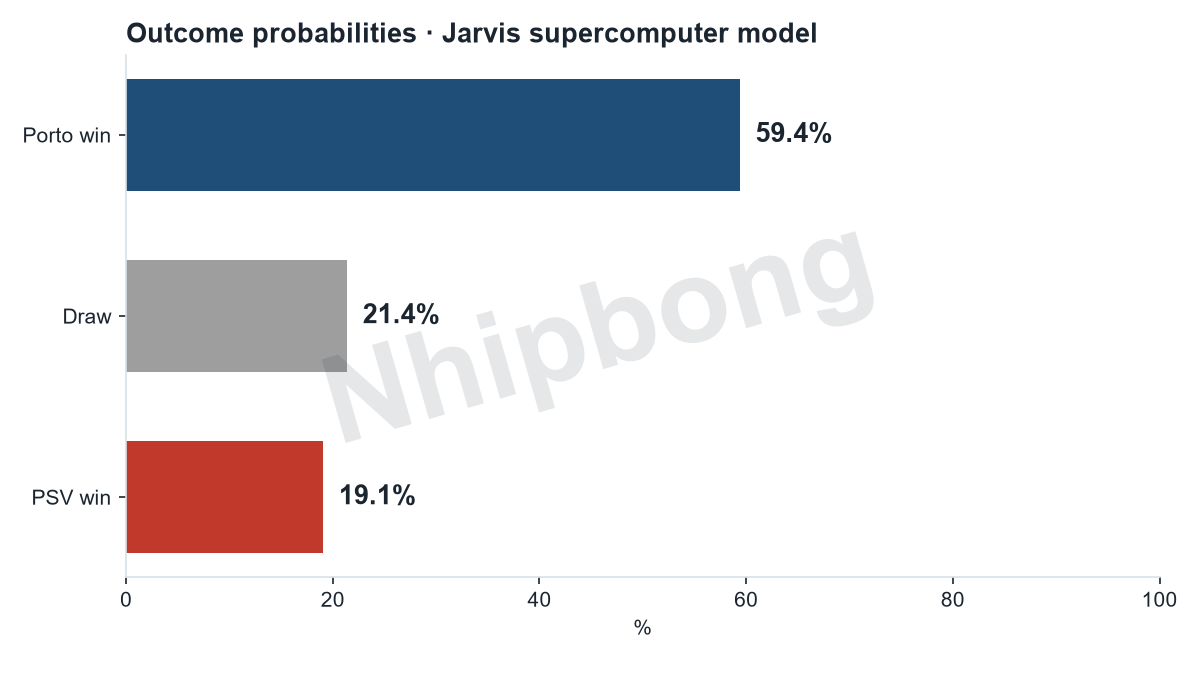
PSV have just lost their last two games and are missing as many as eight players through injury, yet they still have a 19% chance of winning at the Dragão. Where does that number come from? The Jarvis supercomputer model gives Porto 59%, the draw 21% and PSV 19%, with a predicted score of 2–1, and the answer lies more on Porto's side than I expected.
- Jarvis gives Porto a 59% chance of winning, the draw 21% and PSV 19%.
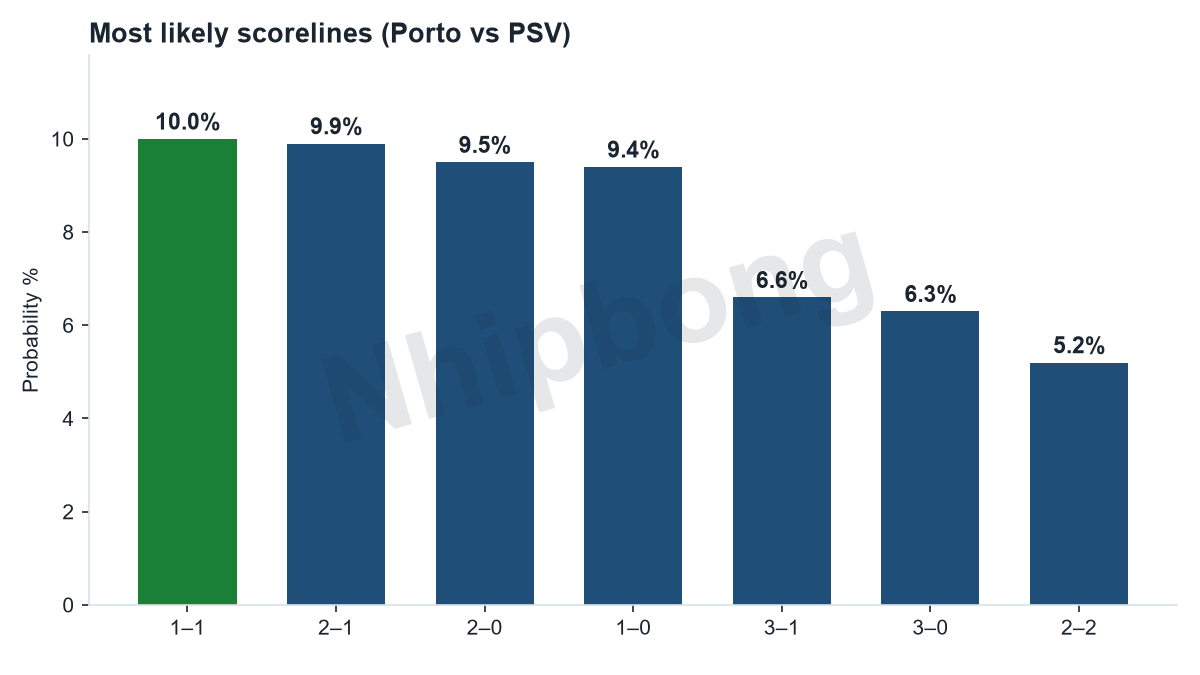
- The predicted score is 2–1, but 1–1, 2–1, 2–0 and 1–0 all sit around 10%.
- PSV lost their last two games and are missing eight players, with Til doubtful; Porto are missing only two.
- Porto won their last three domestic games, including 3–1 against Benfica, but lost both of their latest Champions League games.
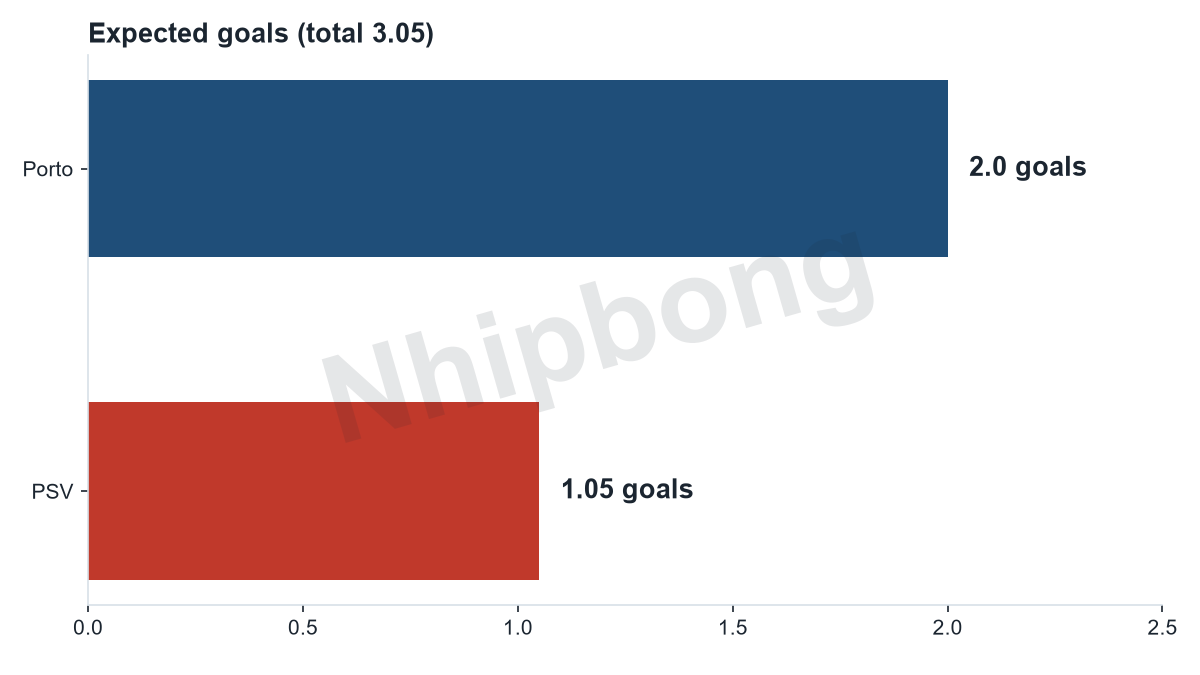
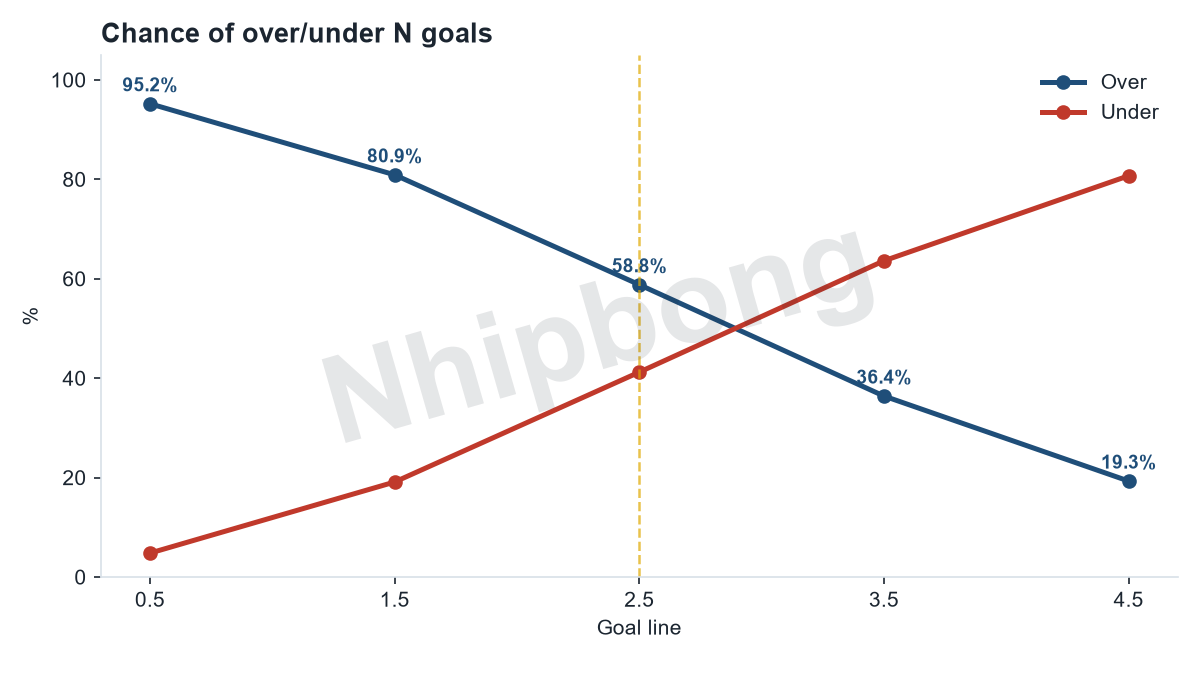
- Expected total goals are about 3.0, the chance of three goals or more is 59%, and confidence is low.
| Outcome | Porto | Draw | PSV |
|---|---|---|---|
| Jarvis probability | 59.4% | 21.4% | 19.1% |
| Metric | Jarvis forecast |
|---|---|
| Expected total goals | 3.05 |
| Predicted score | 2–1 |
| Chance of 3+ goals | 58.8% |
| Confidence | Low |
Why PSV, missing eight players, still keep a 19% chance
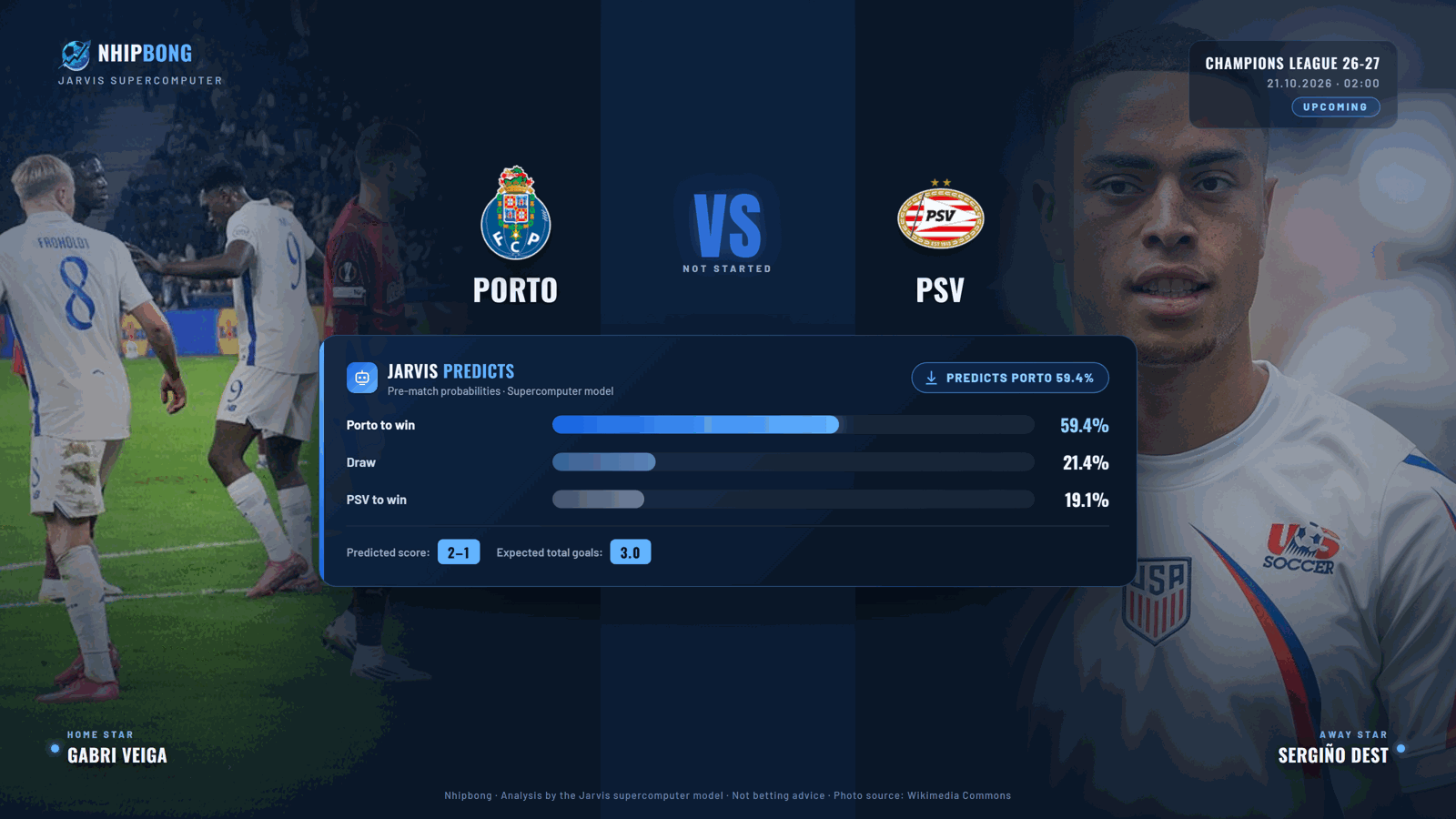
Looking at PSV's injury list, I wondered whether 19% was too generous. Eight players out, plus one doubt, and it is hard to field a full squad for a Champions League away game.
But the 19% reminds me that this game is not decided by the injury list alone. On the other side, Porto have just lost 2–3 to Real Betis in this same competition. A host that has just stumbled is rarely a comfortable host.
Porto win steadily in their domestic league, but the Champions League has not given them a win yet
Inside Porto's last five games there are two very different faces. In the Primeira Liga they beat Casa Pia 4–1, beat Benfica 3–1 at home and won 2–1 at Maritimo. Those are the wins of a side that knows what it is doing.
In the Champions League they lost 0–2 to Man City, then lost 2–3 to Real Betis in their latest game. In all, Porto scored 11 and conceded 8 in five games. The two faces are so different that I find it hard to believe they belong to the same team.
I see a side that wins steadily in its own league, but has not yet found the formula in Europe.
What few people notice: PSV are missing eight, Porto just two

The biggest gap in this game is not in the scoreline table but in the squad lists. PSV have eight players out, two of them still recovering from surgery, plus Til doubtful. Porto are missing only two.
A side missing eight that still has 19% to win, and a 56% chance that both teams score, tells me the model still leaves room for PSV to score. I read that as the sign of a game not yet settled.
Four scorelines side by side: 1–1, 2–1, 2–0 and 1–0
The predicted score is 2–1, but 1–1 is the single most likely scoreline, and the two sit so close together that both are around 10%. Next come 2–0 and 1–0.
The top four scorelines all sit around 10%, which means no single scenario dominates this game. When no scenario dominates, even something small like a corner can change the whole night.
Confidence is low, and I understand why.
PSV scored four in one game and then lost two in a row
PSV began their last five by beating Sparta Rotterdam 4–1, then lost 2–3 at Twente, beat Heerenveen 2–0 and then lost twice in a row: 0–1 at RB Leipzig in the Champions League and 1–2 at ADO Den Haag in the Eredivisie. A run of wins and losses interleaved like that is the sign of a side that has not found its rhythm.
Both of their latest defeats were away, and they scored only one goal across the two. Over the whole run PSV scored 9 and conceded 7. Recent long trips have not been kind to them.
The trip to the Dragão therefore feels more like a test of nerve than an ordinary game.
The only head-to-head in my data is a friendly from 2016
In the data I have, the only time these two met was a friendly on 21 July 2016, which PSV won 3–0.
I do not put much weight on a summer game more than ten years old. But it shows these are two sides with no habit of meeting, so there is no history to go on.
Squads: Porto close to full strength, PSV improvising around a long list of absentees
Porto are without Sousa (leg injury) and William Gomes (ankle), two names that are not enough to change the picture.
PSV are without Lammers (lacking match fitness), Nagalo, Ouaissa (muscle), Pepi, Plea (surgery), Schouten (knee), Sildillia (surgery) and Wanner (foot), with Til doubtful. This list may still change, so I will check it again close to kick-off.
One side short of players, one short of belief: who opens the scoring?
Porto need an opening goal to shake off the feeling of two Champions League defeats. PSV need one to prove that being short of players does not mean being short of character.
A 59% chance for Porto means that out of about every five games like this one, there are still two in which they do not win. I would not be surprised if this were one of those two.
The game kicks off at 19:00 UTC on 20 October (02:00 on 21 October in Vietnam), at the Estádio do Dragão, in the third round of the league phase. This is statistical analysis, not betting advice.
Frequently asked questions
What scoreline does Jarvis give for Porto vs PSV?
Jarvis gives 2–1 for Porto. But 1–1, 2–1, 2–0 and 1–0 all sit around 10%, so it is an anchor rather than a certain scoreline.
Does Jarvis rate Porto or PSV higher?
Porto, at 59% against 19% for PSV, with the draw at 21%. Confidence is low, so this is a tendency, not a promise.
How much do injuries affect PSV?
PSV have eight players out (Lammers, Nagalo, Ouaissa, Pepi, Plea, Schouten, Sildillia and Wanner) and Til doubtful, while Porto are missing only two.
What is the recent form of Porto and PSV?
Porto won their last three domestic games but lost 0–2 to Man City and 2–3 to Real Betis in the Champions League. PSV lost their last two: 0–1 to RB Leipzig and 1–2 to ADO Den Haag.
Should we expect plenty of goals in Porto vs PSV?
Quite possibly: expected total goals are about 3.0, the chance of three goals or more is 59% and the chance that both teams score is 56%.