


Argentina vs Switzerland prediction: the Jarvis supercomputer's verdict
Nhipbong Analytics
Jarvis prediction desk

Argentina meet Switzerland at the World Cup, and the Jarvis supercomputer model leans towards Argentina with a 57% chance of winning. But behind that number sits a match projected to be low on goals, tight in margin and low in confidence. I break down the full set of numbers so you can see why this is a match to read carefully.
- Jarvis leans towards Argentina: 57% chance of winning, 28% draw, 15% for Switzerland.
- The predicted score the model points to is 1–0, tilted towards a low-scoring match.
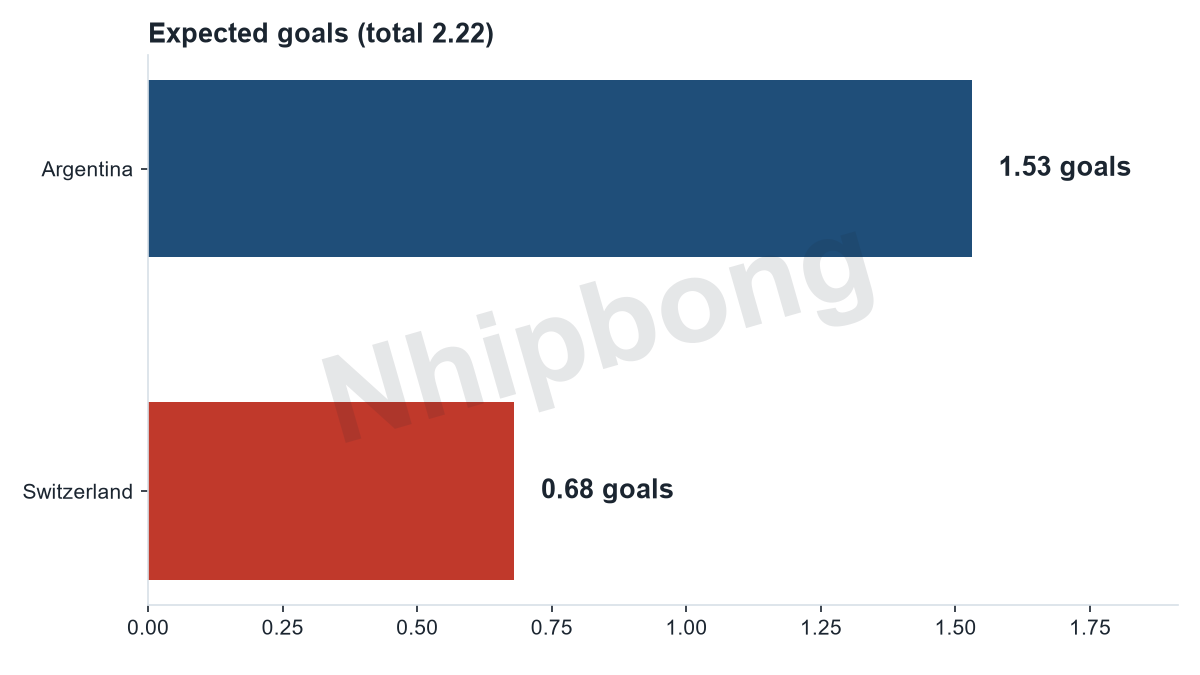
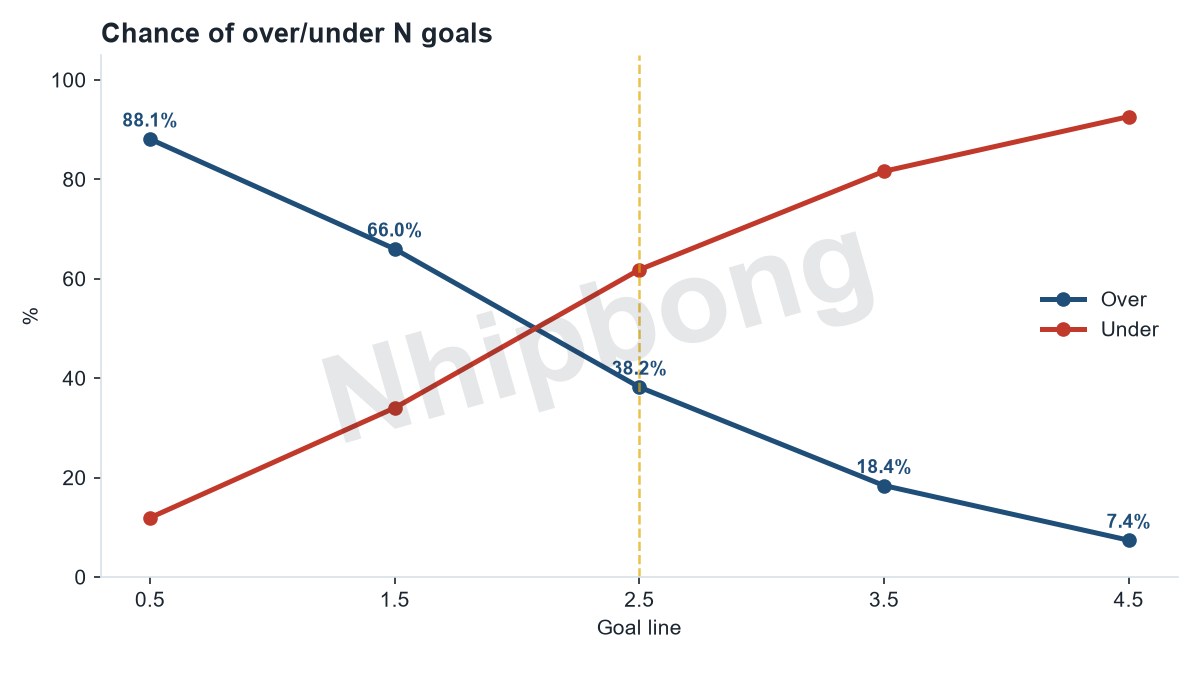
- Expected total goals of 2.194, with the chance of three or more goals at just 38%.
- Confidence: low. Argentina are rated higher, but the gap is not a safe one.
| Outcome | Argentina | Draw | Switzerland |
|---|---|---|---|
| Jarvis probability | 56.7% | 27.7% | 15.6% |
| Metric | Jarvis forecast |
|---|---|
| Expected total goals | 2.22 |
| Predicted score | 2–0 |
| Chance of 3+ goals | 38.2% |
| Confidence | Low |
Will Argentina get past Switzerland?
Will Argentina get past Switzerland at the World Cup? It is the question I have been asked most this week, and the short answer from the Jarvis supercomputer model is: yes, but do not be too sure. Jarvis rates Argentina at a 57% chance of winning, with a 28% draw and Switzerland at 15%.
It leans towards Argentina, true. But everything else adds up to 43%, which means close to half of all scenarios do not end in a win for them. More striking still, Jarvis attaches a low confidence label to this match, a signal I always read very carefully before writing a single line.
The core read: a tilted contest, not a gulf
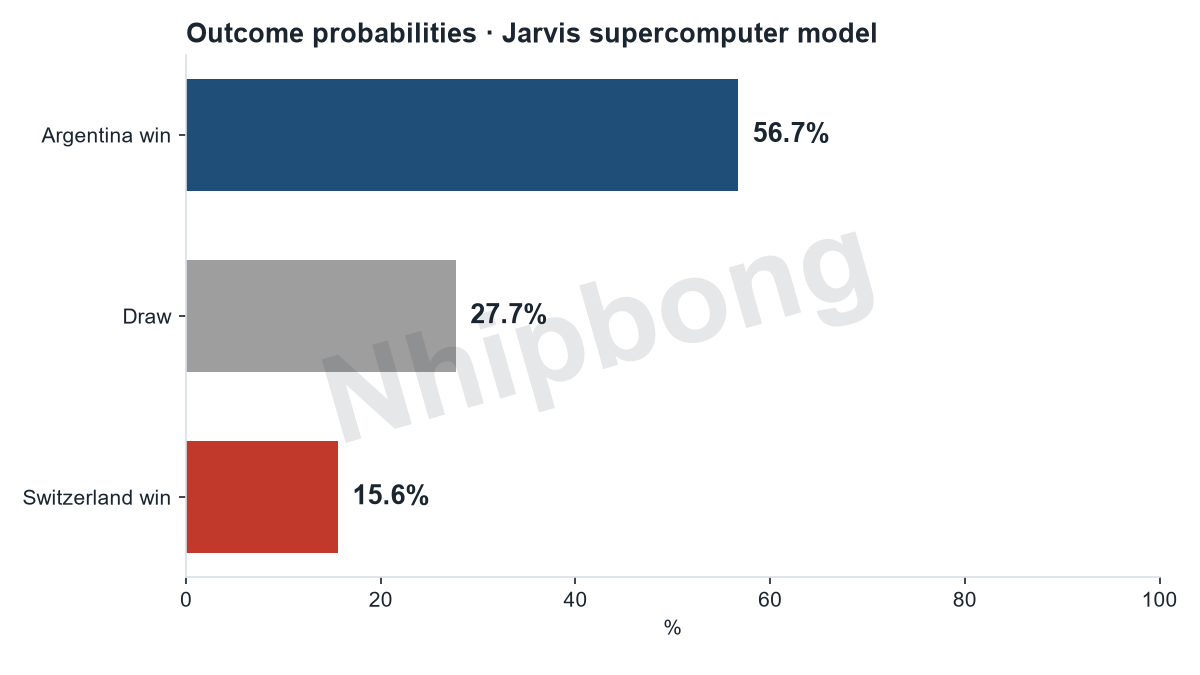
Reading the numbers closely, I see a tilted contest rather than a gulf. 57% for Argentina means that if this match were played over and over in Jarvis's simulations, Argentina would win a little more than half the time, with the rest split between a 28% draw and 15% for Switzerland.
Argentina are the higher-rated side, that much is clear. But the gap between 57% and the 43% carried by the other two outcomes is not a chasm. Add the low confidence label Jarvis has pinned on itself, and I read this as a match where the stronger side holds an edge, but an edge that is thin and easily worn down if Switzerland play with discipline.
The part few mention: this is a low-scoring match
The part few people notice is the goals number. The expected total goals Jarvis puts out is only 2.194, and the chance of the match producing three or more goals is just 38%. Flip that around and roughly 62% of scenarios stop at two goals or fewer. This is not the picture of an open, goal-filled game, but one that leans towards a tight, low-chance affair.
And I want to be clear about something that is often misunderstood: the predicted score of 1–0 that the model points to does not mean 1–0 is the single most likely result. It is the centre of gravity of a whole probability distribution, the way Jarvis sums up the general trend into one easy-to-picture number. The real match may land on a different scoreline, and example numbers like this only illustrate how widely the distribution spreads, not a result the model locks in; what Jarvis puts its name to is a narrow win leaning towards Argentina.
Argentina's form through the Jarvis lens

Argentina reach the quarter-finals with five wins from five. They beat Algeria 3–0, Austria 2–0 and Jordan 3–1 in the group, then found the knockout rounds harder going: they needed extra time to get past Cape Verde 3–2 in the round of 32, and in the round of 16 they were 2–0 down to Egypt before Romero, Messi and Enzo Fernández scored from the 79th minute onwards to win 3–2. Messi leads the way with eight goals in five games, including a hat-trick against Algeria.
For all that perfect record, Jarvis only puts Argentina at a 57% chance of winning, enough to make them the higher-rated side in this tie. In other words, they walk into the match with an edge, but the edge of a slightly better side, not of an overwhelming favourite.
Switzerland's form: do not write them off yet


For Switzerland, a 15% chance of winning sounds modest, but I would advise against filing them under no hope. Add the 28% draw chance and the total set of scenarios in which Switzerland leave the pitch unbeaten rises to 43%.
In a match where expected goals are low and roughly 62% of scenarios feature two goals or fewer, a side willing to defend and drag the game into a stalemate has a real route through. Switzerland's tournament so far suggests they have the tools for exactly that: unbeaten in five, they drew 1–1 with Qatar and beat Bosnia-Herzegovina 4–1 and Canada 2–1 in the group, saw off Algeria 2–0 in the round of 32, then knocked out Colombia 4–3 on penalties after a 0–0 draw in the round of 16. They have conceded only three goals all tournament and kept clean sheets in both knockout games. Switzerland remain the lower-rated side, but a low-scoring backdrop is fertile ground for a team that knows how to sit tight and stay patient.
Head-to-head history
The head-to-head leans heavily towards Argentina. In the last four meetings, Argentina won three and drew one: 2–0 at the 1966 World Cup, 1–1 in a 2007 friendly, 3–1 in a 2012 friendly and 1–0 at the 2014 World Cup. Switzerland did not win any of them.
That said, the most recent of those meetings was back in 2014, and both sides are very different teams now. So I still put more weight on the 57–28–15 split Jarvis gives this match than on the past.
Predicted line-ups
The round-of-16 line-ups are the clearest guide to how both sides will shape up. Against Egypt, Argentina started in a 4-1-3-2 with Emiliano Martínez, Molina, Romero, Lisandro Martínez, Tagliafico, Paredes, De Paul, Mac Allister, Enzo Fernández, Julián Álvarez and Messi. Switzerland lined up in a 4-2-3-1 against Colombia: Kobel, Zakaria, Akanji, Elvedi, Ricardo Rodríguez, Xhaka, Freuler, Ndoye, Jashari, Rieder and Embolo.
As for the mood of the match, the numbers point one way: with expected total goals of only 2.194 and the model's centre of gravity sitting at 1–0, this is most likely the kind of game where both sides prize solidity, and goals arrive from rare moments rather than a flood of chances.
Score prediction and three scenarios

So how does it all settle? The predicted score the Jarvis supercomputer model points to is a 1–0 Argentina win, a result that captures exactly the spirit of the match I analysed above: Argentina slightly better, but in a low-scoring game. I sum it up in three scenarios.
Scenario one, the most likely at 57%: Argentina win. They are the higher-rated side, and the centre of the distribution leans towards a narrow 1–0-style victory.
Scenario two, 28%: the sides share the points. With a low-scoring backdrop and low expected goals, a draw is squarely within the calculation, especially if Switzerland play with discipline.
Scenario three, 15%: Switzerland spring the surprise and take all three points. The lowest probability, but not zero, and this match's low confidence label is a reminder that the chance of an upset is not fully closed.
This is statistical analysis, not betting advice.
Frequently asked questions
Who does Jarvis predict will win Argentina vs Switzerland?
Jarvis leans towards Argentina with a 57% chance of winning, against a 28% draw and 15% for Switzerland. Argentina are the higher-rated side, but the confidence in this forecast is low.
What is the predicted score?
The predicted score the model points to is a 1–0 Argentina win. Keep in mind this is the centre of gravity of a probability distribution, not the single most likely result.
Will there be many goals in this match?
Most likely not. The expected total goals is only 2.194 and the chance of three or more goals is 38%, meaning roughly 62% of scenarios stop at two goals or fewer.
Does Switzerland have a chance?
Yes. Although the chance of winning is just 15%, adding the 28% draw chance takes the total set of scenarios in which Switzerland do not lose up to 43%. A low-scoring backdrop also suits a side that plays tight.
Why is the confidence recorded as low?
Because the gap between the outcomes is not large and the model rates this as a hard-to-call match. I always spell this out so you read the forecast at the right level of certainty.