


Brazil vs Norway prediction: the Jarvis supercomputer's verdict
Nhipbong Analytics
Jarvis prediction desk

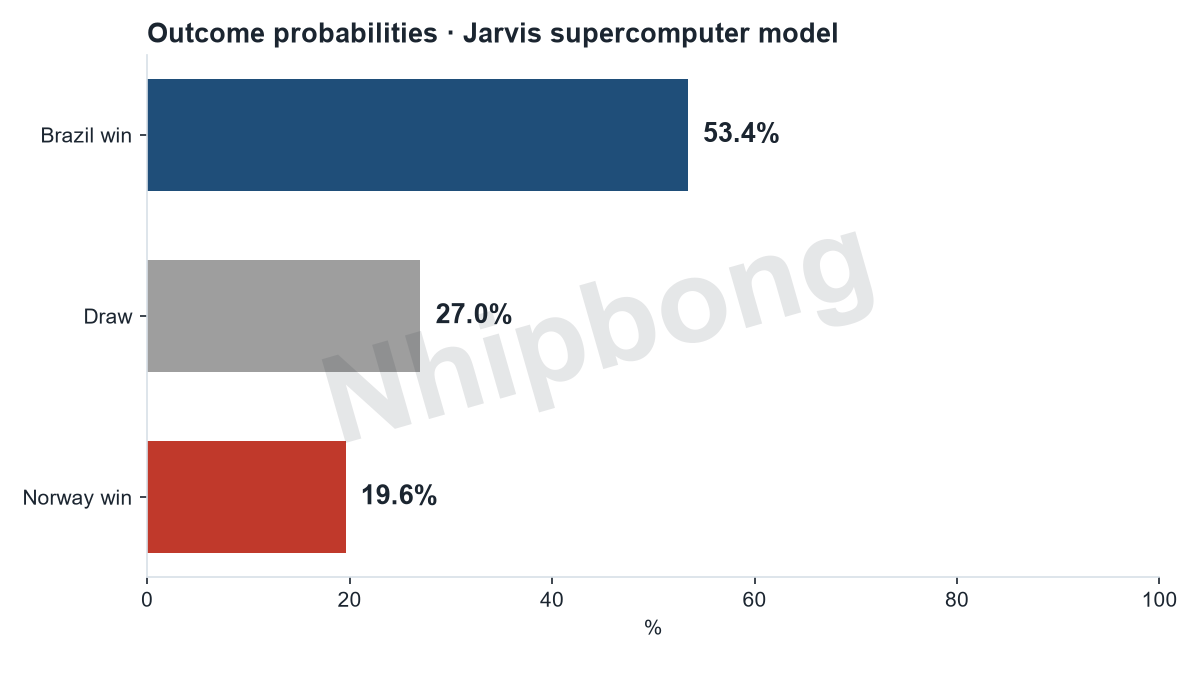
Brazil arrive at the World Cup 2026 round of 16 as clear favourites against Norway, and the Jarvis supercomputer model backs that read: it gives the five-time champions a 51.5% chance of winning inside 90 minutes, with the draw rated at 27.7% and a Norway victory at 20.8%. Those figures point to control rather than comfort, because the numbers underneath them describe a tight, mid-scoring tie in which one goal could decide everything.
- Result: Brazil favoured at 51.5%, draw 27.7%, Norway 20.8% to win in 90 minutes.
- Likely score: the single most probable outcome is 1–1 (13.3%), just ahead of 1–0 Brazil (9.9%).
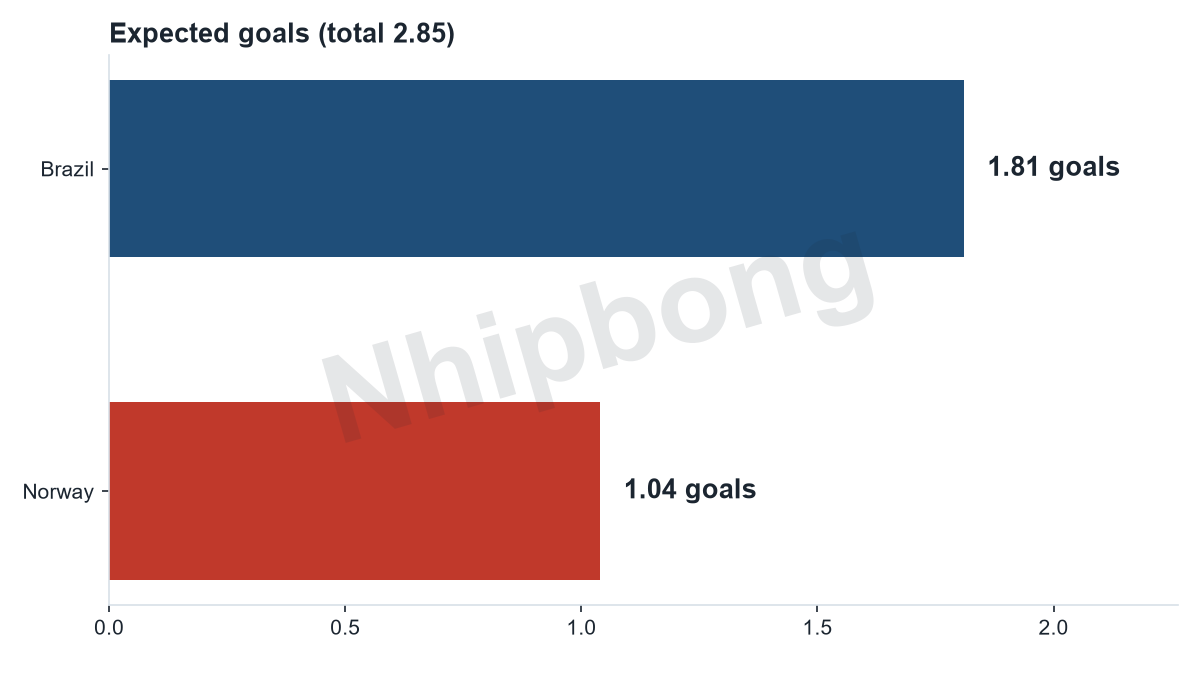
- Goals: Jarvis sees roughly 2.5 total goals, with Over/Under 2.5 close to a 50/50 split.
- Talking point: Norway have never lost to Brazil in four meetings, including a 2–1 win at the 1998 World Cup.
- Confidence: Moderate lean to Brazil, not a strong one, with several attackers injured and Haaland in form.
| Outcome | Brazil | Draw | Norway |
|---|---|---|---|
| Jarvis probability | 51.6% | 27.8% | 20.6% |
| Metric | Jarvis forecast |
|---|---|
| Expected total goals | 2.63 |
| Predicted score | 2–0 |
| Chance of 3+ goals | 49.4% |
| Confidence | Low |
Brazil vs Norway prediction: what the Jarvis model sees


This is a genuine round-of-16 heavyweight test. Brazil, who came through their round-of-32 tie, meet a Norway side that did the same and now carries a small piece of history into the game. The Jarvis supercomputer model has processed both teams and returned a clear but cautious verdict.
On the outright result, Jarvis gives Brazil a 51.5% win probability, with the draw at 27.7% and Norway at 20.8%. That is the profile of a favourite who is expected to control possession and territory without ever pulling clear on the scoreboard.
The scoreline map tells the same story. The most likely single result is a 1–1 draw at 13.3%, narrowly ahead of a 1–0 Brazil win at 9.9%, then 2–0 and 2–1 to Brazil both at 9.7%, and a goalless 0–0 at 8.7%. With an expected total of around 2.5 goals and Over/Under 2.5 close to an even split, Jarvis is describing a measured, low-to-mid scoring tie rather than an open shootout.
Recent form: Brazil steady, Norway streaky
Brazil arrive in strong shape. Their recent run reads as a win over Japan, a comfortable 3–0 win against Scotland, another 3–0 against Haiti and a 1–1 draw with Morocco. The pattern is one of control and clean sheets against lesser opposition, with the Morocco draw a reminder that a well-organised side can frustrate them.
The 2–1 win over Japan is the most instructive of that set, because it shows Brazil closing out a competitive game rather than coasting. Against Scotland and Haiti they dominated, but the Morocco stalemate is the kind of night Norway will be trying to reproduce.
Norway are more streaky. They beat Ivory Coast 2–1, were beaten heavily 1–4 by France, and then recorded a win over Senegal. That France defeat is the warning sign: when the game opens up against elite attacking talent, Norway can concede in numbers.
The read for this tie is that Norway are dangerous when the match stays tight and low-scoring, and vulnerable when it becomes stretched. Their whole game plan is likely to be built around keeping Brazil to the kind of narrow margins the Jarvis scoreline map already favours.
Team news and absences
The injury list is the biggest talking point on the Brazil side. Estevao, Eder Militao, Rodrygo and Raphinha are all reported out with hamstring and knee problems, which strips real depth and creativity from the attacking unit. It leaves Brazil leaning harder on Vinicius Junior and Matheus Cunha to supply the cutting edge.
Norway, by contrast, are reported close to a full squad. That is a meaningful edge for the underdog in a one-off knockout tie, because it means their strongest spine, including Erling Haaland and Martin Odegaard, should be available from the start.
Projected lineups and formations
Brazil are expected to line up in a 4-3-3: Alisson in goal; a back four of Danilo, Gabriel Magalhaes, Marquinhos and Douglas Santos; a midfield of Lucas Paqueta, Casemiro and Bruno Guimaraes; and a front three of Rayan, Matheus Cunha and Vinicius Junior. With several first-choice attackers injured, this shape leans on Casemiro to shield the back line while Paqueta and Bruno Guimaraes drive the transitions to feed Vinicius.
Norway are set up in a matching 4-3-3: Orjan Nyland in goal; a back four of Marcus Pedersen, Kristoffer Ajer, Torbjorn Heggem and David Moller Wolfe; a midfield of Martin Odegaard, Sander Berge and Patrick Berg; and a front three of Alexander Sorloth, Erling Haaland and Antonio Nusa. That gives Norway physical presence through the middle and a direct route to Haaland, with Odegaard the link man tasked with turning defence into fast attacks.
Jarvis deep data: score distribution and goals


Digging into the Jarvis output, the expected total sits at around 2.5 goals, and the Over/Under 2.5 line is effectively a coin flip. That balance is why so many of the top scorelines are decided by a single goal: the model is not expecting either defence to collapse.
The score distribution is instructive. A 1–1 draw leads at 13.3%, then 1–0 Brazil at 9.9%, with 2–0 and 2–1 Brazil both at 9.7% and 0–0 at 8.7%. Stack those together and the picture is a Brazil side that wins or draws in the great majority of simulations, but rarely by a wide margin.
Lower-confidence signals such as corners and cards are not the story here, and Jarvis treats them as secondary. The load-bearing numbers are the tight goal expectation and the clustering of likely scores around zero, one and two goals per side, which is exactly the environment in which a disciplined underdog can steal a result.
You can find more standout fixtures in our daily predictions hub.
Predicted scoreline and how the tie could unfold
Weighing the numbers, the single most likely outcome is a 1–1 draw at 13.3%, with a narrow 1–0 Brazil win the next most probable result. Brazil are favoured, but the model is describing a game settled by fine margins rather than a routine progression.
The most probable path is Brazil controlling the ball and territory, with Vinicius Junior, who has four goals this tournament, the likeliest match-winner. If Brazil score first, the score map tilts toward 1–0 or 2–0. If they do not, the door opens for the draw scenarios that Jarvis rates so highly.
The Norway upset route is clear and credible. They have never lost to Brazil in four meetings, they beat them 2–1 at the 1998 World Cup, and in Erling Haaland, who has five goals this tournament and reached 60 for his country in 53 caps, they hold a striker capable of turning one chance into the decisive goal. A low-scoring, one-goal game is the terrain where that history could repeat.
Frequently asked questions
Who does the Jarvis model favour to win Brazil vs Norway?
The Jarvis supercomputer model favours Brazil with a 51.5% win probability, ahead of a 27.7% draw and a 20.8% Norway win in 90 minutes. It is a clear but moderate lean rather than a strong one.
What is the most likely score for Brazil vs Norway?
The single most likely score is a 1–1 draw at 13.3%, just ahead of a 1–0 Brazil win at 9.9%. A 2–0 and 2–1 Brazil result each sit at 9.7%, so the game projects tight.
How many goals are expected in the match?
Jarvis expects around 2.5 total goals, with the Over/Under 2.5 line close to a 50/50 split. That points to a low-to-mid scoring tie rather than a high-scoring game.
Why is Norway a live threat despite being the underdog?
Norway have never lost to Brazil in four meetings, winning twice including a 2–1 at the 1998 World Cup, and they field Erling Haaland, who has five goals this tournament. In a one-goal game their upset chance is real.