















Liverpool vs Man City prediction: the Jarvis supercomputer's verdict
Nhipbong Analytics
Jarvis prediction desk

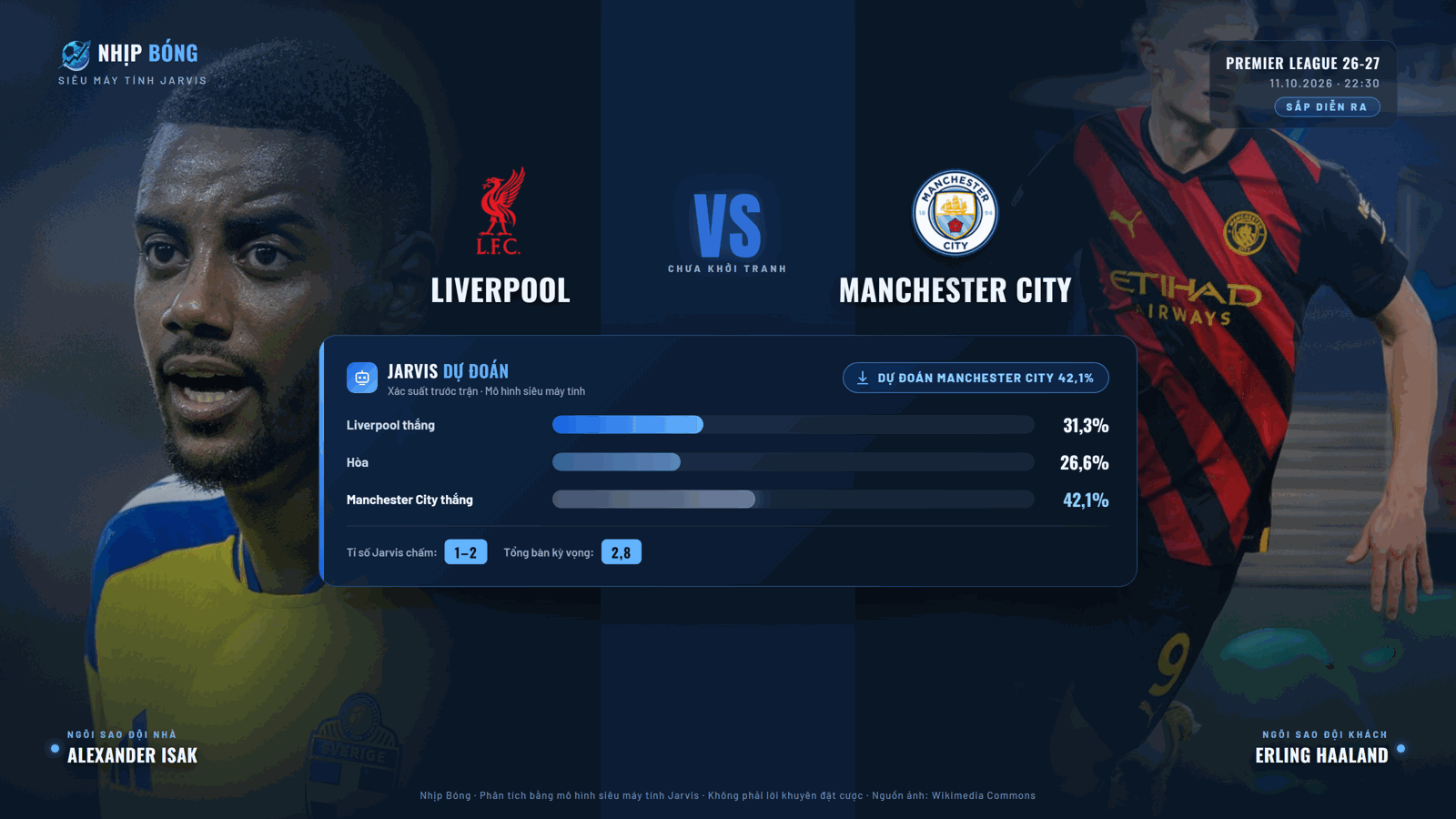
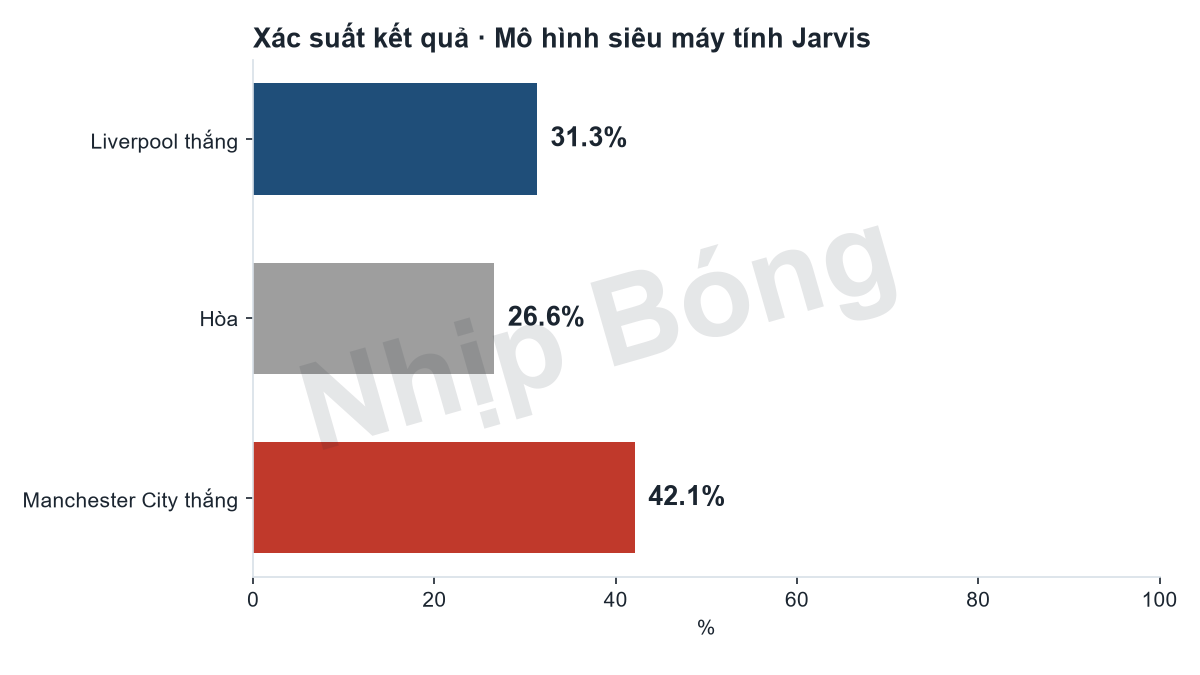
Unbeaten in five, at home, and somehow still rated second best. When Man City come to town, both the model and the recent head-to-head turn their backs on Liverpool. Why? The Jarvis supercomputer model answers neatly: Man City win 42%, draw 27%, Liverpool win 31%, with a representative score of 1–2 tilting towards the visitors. City are genuinely ahead, but they still don't hold even half the chances, and that gap is exactly why this one deserves watching minute by minute.
- The Jarvis supercomputer model gives Liverpool 31%, the draw 27% and Man City 42%; the representative score it points to is 1–2.
- Liverpool are unbeaten in their last five, with four wins and a draw; Man City have won all five.
- Man City have won the last three meetings 9–1 on aggregate, capped by a 4–0 FA Cup thrashing in April 2026.
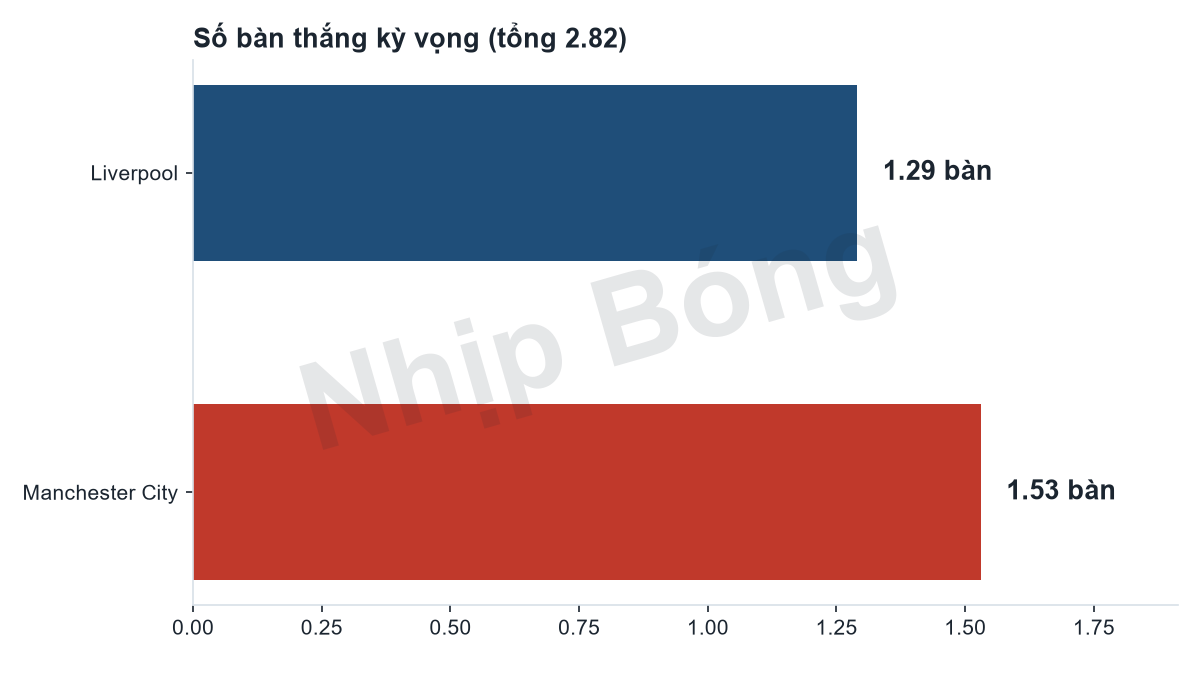
- Expected total goals sit around 2.8, the chance of three or more goals is 53%, and forecast confidence is low.
| Outcome | Liverpool | Draw | Man City |
|---|---|---|---|
| Jarvis probability | 31.3% | 26.6% | 42.1% |
| Metric | Jarvis forecast |
|---|---|
| Expected total goals | 2.82 |
| Likely score | 1–2 |
| Chance of 3+ goals | 53.4% |
| Confidence | Low |
Unbeaten in five, yet ranked second: Liverpool's paradox against Man City

Some matches pull feeling and numbers in opposite directions. Liverpool come into this one looking like a settled side: winning steadily, conceding little, and playing in front of their own crowd. By ordinary logic, they are the team to trust.
Yet the Jarvis supercomputer model leans towards the visitors: Man City 42%, Liverpool 31%, with the rest left for a draw. The answer to the paradox lies in what sits behind that gap. Man City don't just win, they win relentlessly, and they have won the last three meetings with this very Liverpool side.
But look at the other half of the paradox. The side rated higher is still a long way from dominant. In the model's eyes, Liverpool are not being written off at all; they are simply standing behind an opponent carrying a little more momentum.
A telling detail: Man City have already won 2–1 on Liverpool's own ground
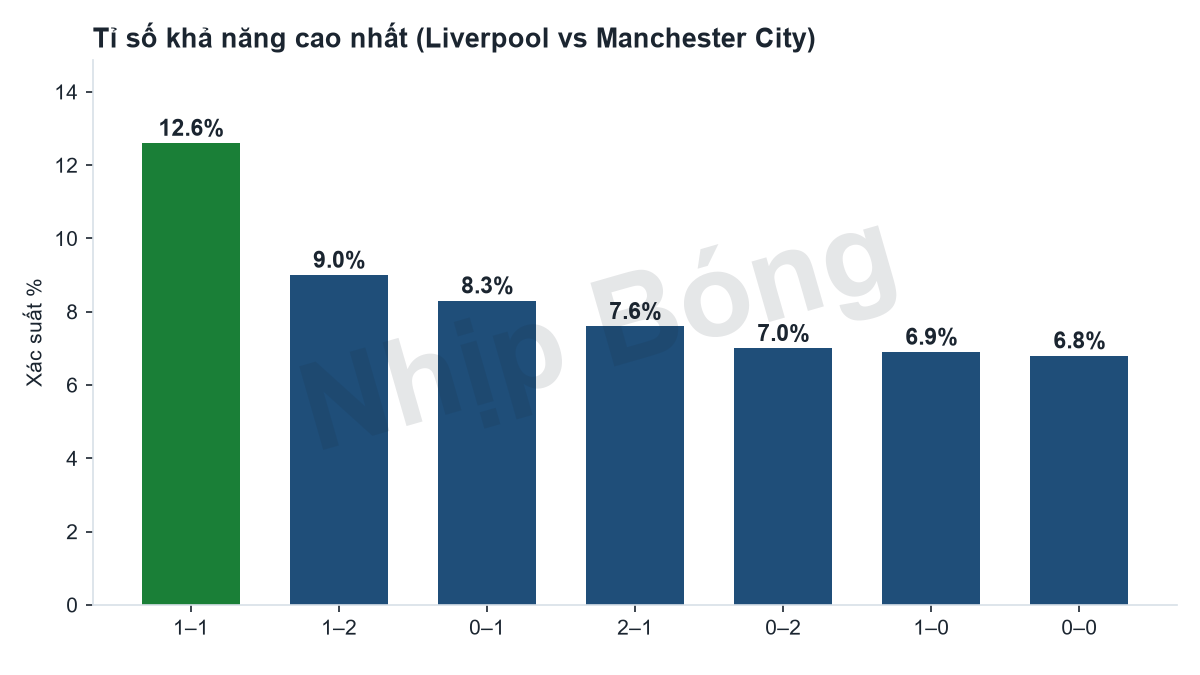
The representative score the model points to is 1–2. That is not the single most likely scoreline; it is a snapshot of where all the scenarios lean overall. The intriguing part is that the last time Man City visited Liverpool, in February 2026 in the Premier League, the game finished exactly that way.
I don't read that as an omen. But it is a reminder that the picture the model paints is hardly unfamiliar. It has already played out on this very pitch, in front of these very stands.
The second detail is the confidence label, which reads low. The model is admitting there are still plenty of grey areas, and the scenarios are not far enough apart to call it one way. A side unbeaten in five meeting a side on a perfect winning run: clashes like that rarely give the answer away in advance.
Liverpool grind, Man City surge: two kinds of form before a heavyweight clash
Look at Liverpool's recent run and what stays with you is not fireworks but solidity. In five games they have conceded just two goals and kept three clean sheets. That points to a disciplined defensive unit, one that knows how to close every gap.
But half of those wins came by a single goal. In the Premier League, they edged Bournemouth 1–0 last time out, and in the league game before that they were held by Fulham in a goalless draw. This is a Liverpool that knows how not to lose, but has not yet truly overwhelmed anyone.
The bright spots come in the bigger games. They got past Atlético Madrid 2–1 in the Champions League and beat Tottenham 3–1 in the Carabao Cup, two results that show this side can still lift the tempo when the opponent is good enough.
Man City tell a completely different story. Five games, five wins, 14 goals scored, and only once has an opponent breached their defence.
The visitors are winning in every way imaginable. There was a rout of Norwich, a narrow win over Manchester United, and even a goal-fest that ended 5–3 against Sunderland.
That last game is the small crack in a defence that looked watertight. Every goal City conceded in this run came in that one match, a sign that when they get dragged into an open game, they can wobble too.
Liverpool are moving slowly but surely, while Man City are charging ahead and occasionally leaving a flank exposed. This match will tell us which approach holds up better when those two currents collide.
Liverpool vs Man City head-to-head: the pendulum has swung firmly one way
The recent head-to-head between these two looks like a pendulum. In late 2024 and early 2025, Liverpool held the upper hand with back-to-back 2–0 wins, one at home and one away at Man City.
Then the pendulum swung back. The last three meetings all belong to Man City, 9–1 on aggregate: a 3–0 in November 2025, a win on Liverpool's own ground in February, capped by a 4–0 FA Cup thrashing in April.
What should worry Liverpool is not just the results but the sense of being stuck in those meetings. Across those three games they found the net only once, even though against other opponents they have been scoring fairly regularly. That kind of hang-up doesn't fully show on a stats sheet. It lives in the players' heads.
One more thing worth noting. None of the last five meetings ended in a draw, and four of them were settled by two goals or more. That fits neatly with the draw being the scenario the model ranks lowest.
For Liverpool, then, this match is about more than points. It is a chance to stop a head-to-head run that is slowly turning into a hoodoo.
Two attacks, two ways of scoring: why Liverpool vs Man City could produce more goals than you'd expect


Look only at the defences and you would picture a tight game, since both sides are used to keeping clean sheets. But the model reads it differently: expected total goals of around 2.8, and a 53% chance of three or more.
The answer lies in how the two attacks are working. Man City can explode at any moment, and twice in this recent run they have hit five.
Liverpool are the opposite. They don't score many, but they rarely draw a blank. Apart from the Fulham draw, they have found the net in every game of their recent run.
When an attack used to dominating meets a home side that has to hit back to escape a losing head-to-head run, the game can easily get stretched. An early opener could send both teams charging forward, and that is when space opens up at both ends.
Seen from that angle, the scenario the model points to has its own logic. Liverpool still score, Man City stay a step ahead, and the game is anything but closed.
The open question: will Liverpool break the head-to-head run or let it stretch on?
Every calculation has its limits, and this match sits right at the edge of them. One side wants to prove its consistency is real. The other wants to prove its recent dominance in this fixture is no accident.
Liverpool have home advantage, a defence that is holding firm, and a nagging frustration that needs releasing. Man City have winning momentum, plus fond memories against this very opponent to lean on.
I lean with the model's reading: the visitors have the edge, but it is nowhere near a mismatch. Whether the home crowd can turn the paradox at the top of this piece into a night of raw emotion, only the next 90 minutes will tell us.
This is statistical analysis, not betting advice.
Frequently asked questions
Which side does the Jarvis supercomputer model favour for Liverpool vs Man City?
The visitors. Man City are rated at 42%, Liverpool at 31% and the draw at 27%, so City sit a step above, but they are far from certain to win.
Is 1–2 the most likely score?
No. It is the representative score the model points to, reflecting the overall lean of the scenarios rather than the single score with the highest probability. As it happens, it was also the result the last time Man City visited Liverpool, in February 2026.
How have recent meetings between the two gone?
Man City have won the last three, 9–1 on aggregate, including a 4–0 in the FA Cup in April 2026. Before that run, Liverpool had won two in a row, both 2–0.
Will there be many goals in this match?
The model leans slightly towards an open game: expected total goals of around 2.8 and a 53% chance of three or more.
What does the low confidence label tell us?
That the model doesn't see any scenario as dominant. With a home side unbeaten in their last five facing visitors on a perfect winning run, the gap between outcomes is narrow enough that a surprise is still within reach.