


France 3–0 Sweden: how the Jarvis supercomputer's prediction held up
Nhipbong Analytics
Jarvis prediction desk

France beat Sweden 3–0 at the FIFA World Cup, a result that lines up with the clearly France-leaning forecast the Jarvis supercomputer model put out before kickoff. Let's walk back through the pre-match numbers and see how they measure up against what actually happened on the pitch.
- France beat Sweden 3–0 at the FIFA World Cup.
- Jarvis gave France a 75% chance of winning before kickoff, a call that matched the final result.
- Jarvis's predicted score was 2–0, one goal short of the actual 3–0 scoreline.
- The actual goal tally (3) landed very close to the model's expected goals figure of 3.1756.
- Jarvis tagged this match with a LOW confidence label.
| Outcome | France | Draw | Sweden |
|---|---|---|---|
| Jarvis probability | 75% | 16% | 8% |
| Metric | Jarvis forecast |
|---|---|
| Expected total goals | 3.18 |
| Predicted score | 2-0 |
| Chance of 3+ goals | 61.5% |
Head to head: Jarvis prediction vs the actual result
| Category | Prediction (pre-match) | Actual | Correct? |
|---|---|---|---|
| Winner | France (75%) | France (3–0) | ✓ Right |
| Predicted score | 2–0 | 3–0 | ✗ Off |
| Expected total goals | 3.2 goals | 3 goals | ≈ Close |
| Chance of 3+ goals | 61.5% | Yes | ✓ Right |
The Big Picture: A Comfortable Win for France
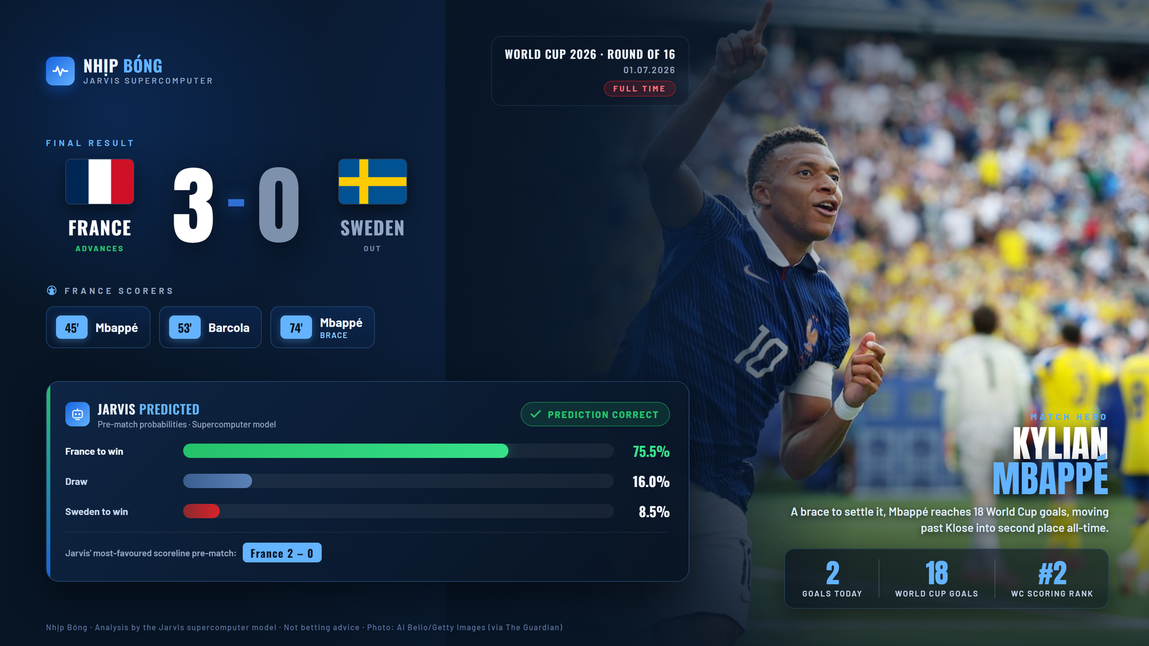
France closed out their meeting with Sweden at the FIFA World Cup with a 3–0 win, a margin wide enough to leave little room for debate about who ran the game. Scoring three and keeping a clean sheet at the other end is the kind of result that usually demands a team perform well at both ends of the pitch.
At international level, a three-goal winning margin is rarely a fluke. It tends to reflect a genuinely lopsided contest, where the stronger side both created enough chances to score three and shut down the space needed for the opponent to reply. Within the framework of a major tournament like the World Cup, where every match carries its own weight, a win by this margin only sharpens how clearly one side dominated on the day. The final score, 3–0 to France, already tells most of the story about how the balance of play went.
Highlights


The most memorable part of the match was the clean sheet. France didn't just win, they won without letting Sweden find the net even once, turning the victory into a display of control at both ends of the pitch. Keeping a clean sheet against a national team is always a clear sign that the defence and midfield were functioning smoothly, not just that the attack was firing.
For Sweden, going home without a single goal is a hard result to take, suggesting they found almost no answer to their opponents' defence for the whole match. Pairing three goals with an untouched net makes this a genuinely complete win: sharp in the final third and solid at the back. For a side rated as highly as France, that's about as clean a scenario as you can hope for over 90 minutes.
Jarvis Checked Against Reality: Pre-Match Forecast vs Actual Result


Before kickoff, the Jarvis supercomputer model marked France as the clear favourite across the three possible outcomes: 75% for a France win, 16% for a draw, and 8% for a Sweden win. On the most fundamental question, who wins, the model called it correctly: France took all three points with a 3–0 scoreline.
On the predicted score, Jarvis pointed toward 2–0 in France's favour. It's worth stressing here: this is a score meant to represent the direction the model leans, not the single most likely scoreline in an absolute sense. The actual 3–0 result missed that mark by exactly one goal, but it kept the same shape as a match Jarvis expected, France dominant and keeping a clean sheet, just with a wider margin than pencilled in.
On total goals, this is the comparison I find most interesting. Jarvis put the expected goal tally for this match at 3.1756, and gave a 61% chance of the match producing three goals or more. The actual goal count came in at 3, a gap of only around 0.18 goals from the expected figure, a genuinely small margin of error. At the same time, hitting exactly three goals also fell into the higher-probability bracket (61%) that the model had flagged beforehand.
What the LOW Confidence Label Actually Tells Us


One detail that's easy to skim past but matters: Jarvis tagged this match with a LOW confidence label. That tag isn't some vague warning that the forecast might be wrong, it's the model's own way of acknowledging that this particular match had a wider-than-usual range of plausible outcomes, meaning the spread between possible scenarios was larger than it would be for a match where the model feels highly confident.
Against that backdrop, it's worth noting that a forecast tagged LOW still called the correct winner and stayed close on total goals. It shows that even when the model is cautious about certainty, its read on the direction of the result and the scoring tempo of this match held up, it was only the exact scoreline that missed by a goal. A reasonable way to read it: treat the confidence label as a guide to how much weight to put on the fine details, a LOW-rated match means trust the broad direction but stay cautious about the precise numbers, while a high-confidence match would justify putting more faith in the specific score the model leans toward. In other words, LOW describes how certain the forecast is, not whether the forecast points the wrong way.
What the Probabilities Actually Mean
That 75% figure for France before kickoff wasn't a guarantee, it's a probability saying that, in the model's picture of things, if a match like this played out around three times, France would win more than two of them. The remaining slices, 16% for a draw and 8% for Sweden, aren't meaningless just because they didn't happen in this particular match, they remain real possibilities, just less likely ones.
A single match, whether it lines up with the pre-match percentages or not, isn't enough on its own to prove or disprove how accurate a model is. Probabilities are best judged across many matches and many scenarios, not through any one isolated result. Thinking in probabilities, then, isn't about nailing every scoreline, it's about honestly describing how much certainty can reasonably exist before an event that hasn't happened yet. In this match, the outcome the model rated most likely, a France win, is exactly what played out, and that's about as much as any single result can confirm.
Data Source
All the probabilities, the predicted score, the expected goals figure, and the confidence label in this piece come from the Jarvis supercomputer model, calculated before the match was played. The actual 3–0 scoreline used for comparison is the final result of the match.
This is statistical analysis, not betting advice.
Frequently asked questions
What was the final result of the France vs Sweden match?
France beat Sweden 3–0 at the FIFA World Cup.
What did Jarvis predict before the match?
The Jarvis supercomputer model gave three outcome probabilities, a 75% chance of a France win, 16% for a draw, and 8% for a Sweden win, along with a predicted score of 2–0 in France's favour.
Who scored in the match?
Kylian Mbappé opened the scoring for France on 45 minutes, Bradley Barcola made it 2–0 on 53, and Mbappé wrapped up the 3–0 win on 74. Sweden did not score.
Was Jarvis's 2–0 predicted score a wrong prediction?
Not exactly. The predicted score reflects the direction the model leans, not the single most likely scoreline in an absolute sense. The actual 3–0 result missed that mark by one goal but kept the same overall shape, a dominant France performance with a clean sheet.
What does the LOW confidence label Jarvis attached to this match mean?
A LOW label signals that the range of plausible outcomes was wider than usual, meaning the model saw this match as harder to pin down in detail, even though the broader direction, the favourite going on to win, held firm.