


Spain 3–0 Austria: how the Jarvis supercomputer's prediction held up
Nhipbong Analytics
Jarvis prediction desk

Spain beat Austria 3–0, a tidy, clean-sheet win of the kind a heavyweight is supposed to produce against a lower-rated opponent. The Jarvis supercomputer model called the winning side correctly before a ball was kicked, but the detail worth unpacking is the scoreline: the 2–0 predicted score Jarvis put forward pre-match was only the centre of its outcome distribution, not its ceiling, and the 3–0 final score out on the pitch landed squarely in the higher-goals branch the model had already accounted for.
- Spain beat Austria 3–0, keeping a clean sheet throughout.
- Pre-match, Jarvis rated Spain to win at 74%, a draw at 18%, and Austria to win at just 8%.
- The model's predicted score was 2–0, with expected total goals at 2.681 and a 50% probability of the match producing three or more goals.
- The actual result matched the predicted direction, but the 3–0 scoreline went past the predicted score, even though it still fits the 50% scenario mentioned above.
- Mikel Oyarzabal scored twice, in the 36th and 89th minutes, and Pedro Porro headed in the other in the 66th. Before kickoff, the forecast carried only a LOW confidence label.
| Outcome | Spain | Draw | Austria |
|---|---|---|---|
| Jarvis probability | 74% | 18% | 8% |
| Metric | Jarvis forecast |
|---|---|
| Expected total goals | 2.68 |
| Predicted score | 2-0 |
| Chance of 3+ goals | 50.2% |
Head to head: Jarvis prediction vs the actual result
| Category | Prediction (pre-match) | Actual | Correct? |
|---|---|---|---|
| Winner | Spain (74%) | Spain (3–0) | ✓ Right |
| Predicted score | 2–0 | 3–0 | ✗ Off |
| Expected total goals | 2.7 goals | 3 goals | ≈ Close |
| Chance of 3+ goals | 50.2% | Yes | ✓ Right |
The Heavyweight Wins Exactly on Script
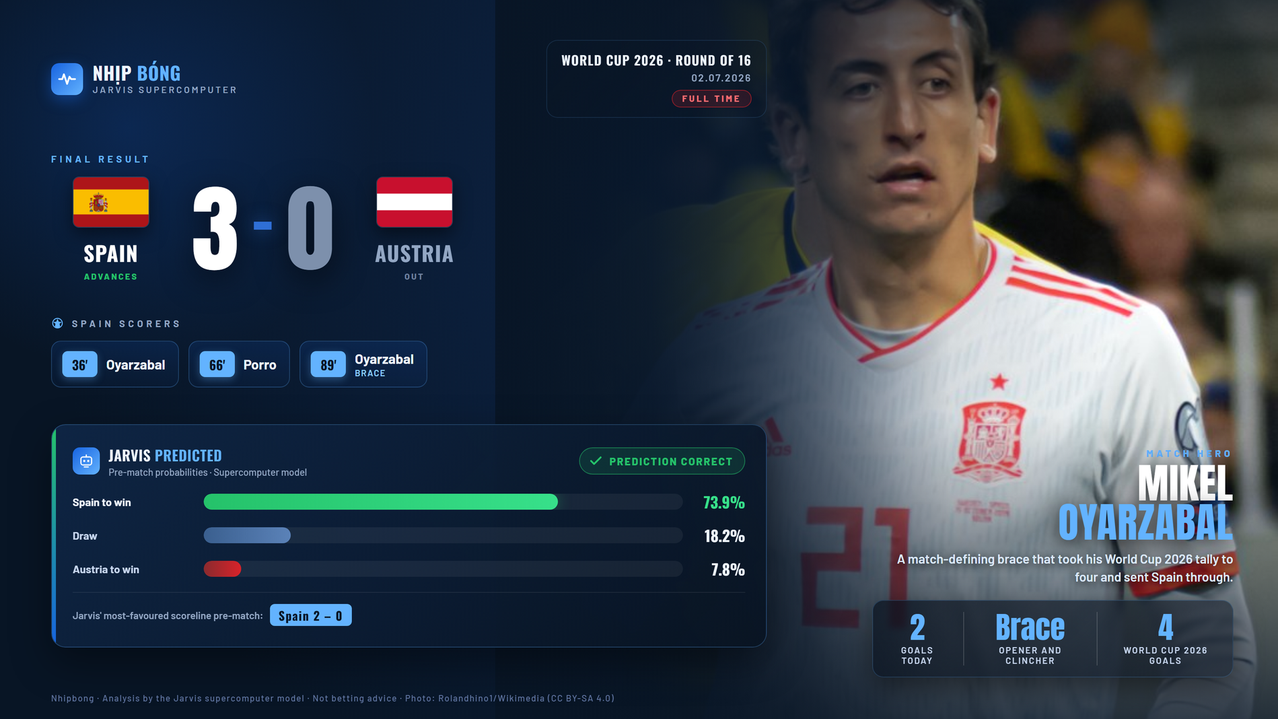
Three goals scored, none conceded, a clean sheet for the full ninety: this is the kind of win you expect from a team in the heavyweight bracket when it runs into a clearly lower-rated opponent. A three-goal margin like this usually points to a match that tilted heavily one way. For a side at World Cup level, keeping a clean sheet without the goalkeeper having to make a single save is the clearest sign of control: Austria had 5 attempts and none of them hit the target.
Mikel Oyarzabal opened the scoring in the 36th minute from a Marc Cucurella cross, Pedro Porro headed in the second in the 66th with Álex Baena providing the assist, and Cucurella then set up Oyarzabal for the third in the 89th. One goal before the break, two after it: a win built steadily rather than in a rush. From here, the part most worth analysing is the Jarvis forecast issued before kickoff, and what the 3–0 result tells us about how to read those numbers.
Jarvis Checks Itself: Pre-Match Forecast vs Actual Result
Before kickoff, Jarvis laid out three scenarios for this fixture: Spain to win at 74%, a draw at 18%, and Austria to win at just 8%. The gap is enormous, given that the 74% figure alone outweighs the other two combined at 26%, meaning the pre-match data tilted almost entirely toward Spain. On direction, the actual result confirmed this scenario exactly.
The interesting part is the scoreline. Jarvis doesn't commit to a single number; instead it sets a predicted score, at 2–0 in this case. This is the single most typical shape for the entire distribution of possible outcomes, not the ceiling of that distribution. The evidence sits right next to it: alongside the 2–0 figure, the model set expected total goals at 2.681 and assigned a 50% probability to the match producing three or more goals. In other words, Jarvis had already treated a high-scoring match as roughly a coin flip against a low-scoring one from the outset. The 3–0 result doesn't break the forecast, then; it lands right in the higher branch the model had set aside half its probability for.
One more detail worth putting on the table: Jarvis tagged this forecast with LOW confidence, meaning the model itself acknowledged a wider-than-usual band of uncertainty. The 3–0 result still fell on the favoured side, and that's a neat illustration of something easy to misread: a low-confidence label doesn't mean the forecast was wrong, only that the range of plausible outcomes was wider, with a three-goal margin sitting at the upper end of that range.
A Tactical Angle Through the Probability Lens


Looking at this through the probability lens, there are a few things you can read about the shape of the match rather than trying to guess a specific scoreline. Expected total goals of 2.681 leans toward a moderately scoring match, not a flood of goals. Combined with Spain being rated well clear of Austria, 74% against 8%, this framework sketches a match where the goal count isn't huge but flows almost entirely in one direction.
That's what the probability framework suggests about the distribution: when one side is favoured to this degree, most of the goals that do appear are likely to come from that side, rather than a back-and-forth chase between the two teams. A one-sided match, decided by a few goals with little chance for the underdog to claw back, is the natural shape for this kind of probability framework, more so than a high-scoring draw or a major upset from Austria's side.
The match numbers fit that template: Spain had 64.4% of the ball, 23 attempts with 10 on target and 9 corners, while Austria did not win a single corner.
What the Probability Figure Actually Means

A number like 74% can make people think the result was almost certain, but at its core it's just the relative confidence between three scenarios. Spain winning was the highest-rated scenario, while a draw and an Austria win remained real possibilities, just far less likely ones. 74% isn't a promise of a result; it's the probability weighting calculated at the moment the model ran, before kickoff.
Spain against Austria is a case where the highest-probability scenario played out, but it comes with a LOW tag as a reminder: even when one team is rated well clear, a margin of uncertainty remains, and the actual goal margin can end up wider or narrower than the initial predicted score. Reading probability correctly means looking at all three scenarios at once, rather than fixating on the highest number and treating it as a guaranteed outcome.
Data Source and Notes
All the probability figures, the predicted score, expected total goals, and the confidence label in this article come from the Jarvis supercomputer model, calculated before the match kicked off. The actual 3–0 scoreline was recorded after the final whistle, used here to check against the forecasts above. The scorers and goal times (Oyarzabal in the 36th and 89th minutes, Porro in the 66th), along with the possession and shot figures, come from the match data.
This is statistical analysis, not betting advice.
Frequently asked questions
What was Jarvis's pre-match score forecast for Spain vs Austria?
Jarvis doesn't issue a single fixed score prediction; instead it set the predicted score at 2–0 in Spain's favour, alongside a 74% win probability for Spain, 18% for a draw, and 8% for Austria.
Does Spain's 3–0 win match Jarvis's assessment?
On direction, yes: Spain winning was exactly the scenario Jarvis rated highest, at 74%. On the scoreline, 3–0 is higher than the predicted score of 2–0, but it still falls within the three-or-more-goals branch the model assigned a 50% probability to before kickoff.
What does Jarvis's predicted score of 2–0 actually mean?
It's the single most typical shape for the entire distribution of outcomes the model calculated, not a score expected to match exactly, and not the largest possible margin either. That's why a result like 3–0 can still sit above the predicted score without falling outside the forecast range.
What does the LOW confidence label on this forecast mean?
The LOW label shows that the model itself flagged a wider-than-usual margin of uncertainty for this match, meaning a broader range of plausible outcomes. That doesn't mean the forecast was wrong, and in this match the 3–0 result still fell on the favoured side.
Who scored for Spain in this match?
Mikel Oyarzabal scored twice, in the 36th and 89th minutes, and Pedro Porro headed in the other in the 66th.