


France vs Spain prediction: the Jarvis supercomputer's verdict
Nhipbong Analytics
Jarvis prediction desk

A World Cup semi-final, with just one spot in the final for the winner. France against Spain is exactly the kind of tie fans wait an entire tournament for: both sides have already come through a long road to reach the last four, where a single moment can decide everything. What stands out is that even a machine like Jarvis can't pull these two names far apart, the supercomputer model rates this as one of the most evenly matched fixtures of the whole tournament. I'm going to break down every number Jarvis has produced, from the individual outcome probabilities to the goal expectations, to see exactly where that balance really sits.
- Jarvis rates France with the highest win probability at 41%, compared with 28% for Spain and 31% for a draw.
- The predicted score the model points to is 2–1 in France's favour.
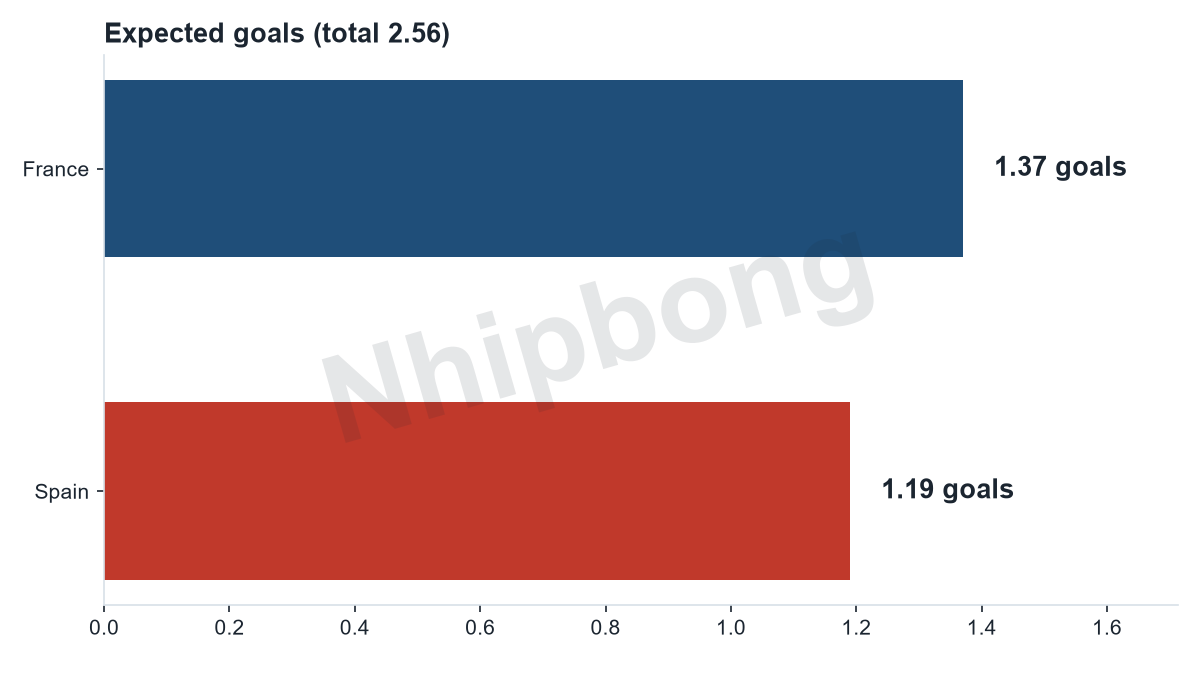
- Total expected goals for the match is 2.53.
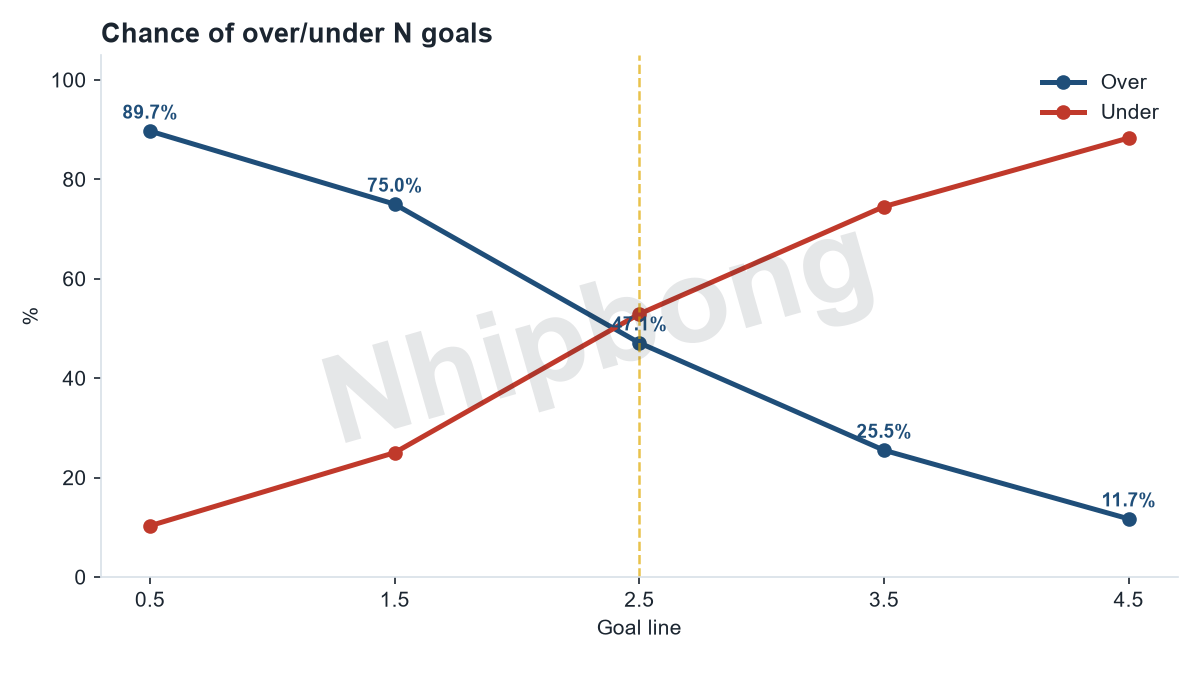
- The probability of the match going over 2.5 goals is 46%, and the probability of both teams scoring is 53%.
- Jarvis has rated the confidence level on this prediction as low.
| Outcome | France | Draw | Spain |
|---|---|---|---|
| Jarvis probability | 40.8% | 31.5% | 27.7% |
| Metric | Jarvis forecast |
|---|---|
| Expected total goals | 2.52 |
| Predicted score | 2–1 |
| Chance of 3+ goals | 46.1% |
| Confidence | Low |
France vs Spain: What to Know Before the Semi-Final

The France vs Spain match sits at the World Cup semi-final stage, the milestone every national team dreams of reaching. Before diving into the analysis, let me quickly answer a few basic questions people tend to ask.
Which side is rated higher? According to the Jarvis supercomputer model, France is rated higher with a 41% win probability, while Spain sits at 28%. The probability of a draw is 31%, a fairly high figure that shows the gap between the two sides is not large.
Which score does the model point to? Jarvis gives a predicted score of 2–1 in France's favour, alongside a total expected goals figure of 2.53 for the match. These are the foundational numbers I'll break down further in the sections below.
Main Read: A Narrow Gap Between All Three Outcomes
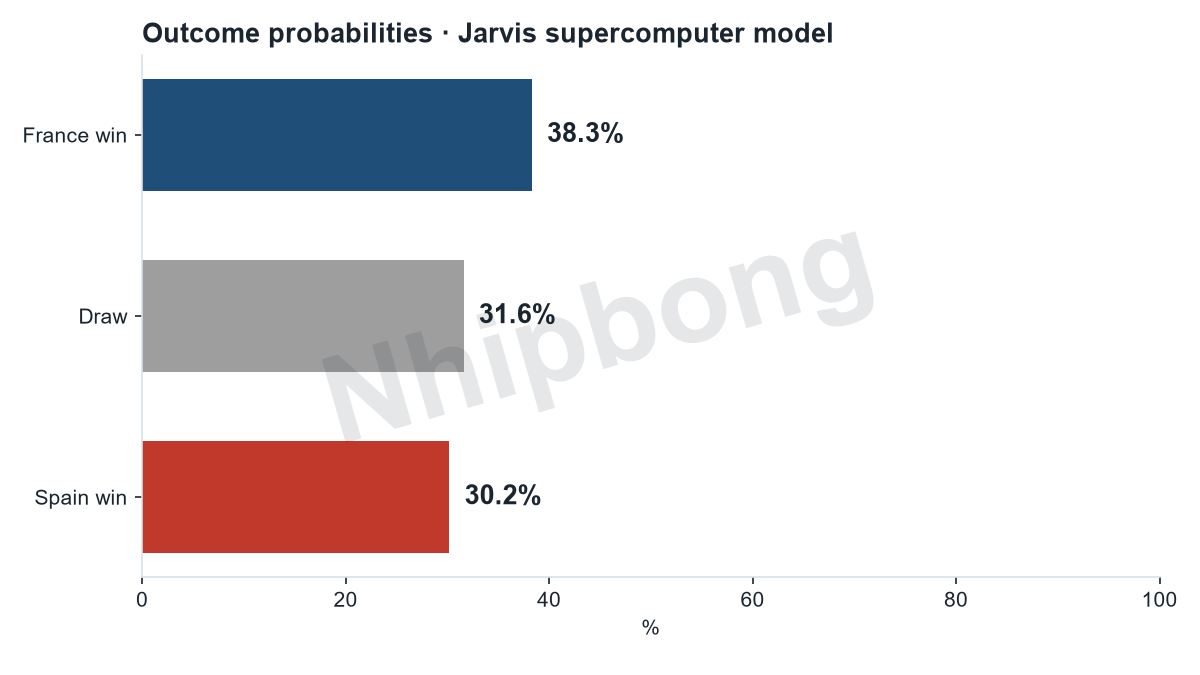
Looking at the three probabilities Jarvis has produced, the most telling detail isn't that France leads, it's the order right behind it: the probability of a draw (31%) ranks above Spain's chance of winning (28%). In other words, the model's second-favoured outcome isn't a win for either side, it's the scenario where nobody wins inside 90 minutes. That's a familiar signature of a genuinely tense semi-final, one where normal time might not be enough to settle things. France holds an edge, but a thin one: just 13 percentage points over Spain, and the gap to the draw scenario is even tighter, only 10 percentage points.
On goals, Jarvis projects a total of 2.53 for the match, a figure that sits in the middle ground rather than pointing to a goal rush. Paired with the tight structure above, the model is sketching a tense contest rather than an open one. There's one more interesting wrinkle in the goals picture, which I'll unpack on its own in the next section.
What Few People Mention: Low Confidence and What It Really Means
Something worth stressing is that the confidence level on this prediction has been rated low by Jarvis. That doesn't mean the numbers are meaningless, but they should be read as a general lean rather than a firm declaration. In a World Cup semi-final, the variables around pressure and decisive moments run higher than usual, and the model's own low confidence rating reflects that caution.
One detail that tends to get overlooked: the probability of both teams scoring (53%) is actually higher than the probability of the match going over 2.5 goals (46%) and the probability of three or more goals (46%). In other words, the model leans toward both sides finding the net, but the overall goal tally is more likely to land at a moderate level rather than turning into a goal-fest.
France's Recent Form

France reach the semi-final with a perfect record: six games, six wins. They beat Senegal 3–1, Iraq 3–0 and Norway 4–1 in the group, then saw off Sweden 3–0 in the round of 32, Paraguay 1–0 in the round of 16 and Morocco 2–0 in the quarter-final. That is 16 goals scored and only 2 conceded. Kylian Mbappé has eight goals, and Ousmane Dembélé has five, including a hat-trick against Norway. Jarvis reflects that standing with 41%, the highest win probability of the three outcomes, meaning the model places France as the slight favourite for this semi-final, even if the gap to the rest isn't large.
Spain's Recent Form


Spain are unbeaten on the road to the semi-final too. They opened with a 0–0 draw against Cape Verde, then won five in a row: Saudi Arabia 4–0, Uruguay 1–0, Austria 3–0 in the round of 32, Portugal 1–0 in the round of 16 and Belgium 2–1 in the quarter-final. Their defence has been breached only once in six games. Mikel Oyarzabal leads the attack with four goals, while Mikel Merino scored the winner in both of their last two knockout ties, in stoppage time against Portugal and in the 88th minute against Belgium. With a record like that, Jarvis's 28% shouldn't be read as an underdog's label: it's comfortably above a quarter, so if this match were replayed many times under the same conditions, there would still be a meaningful share of those replays where Spain are the side going through. That's the distance of an awkward opponent, not a makeweight name.
Head-to-Head History Between the Two Sides
Their last five meetings show how little separates them: Spain have won three, France two. Spain took the two most recent, 5–4 in the 2024-25 Nations League and 2–1 at Euro 2024. Before that, France won 2–1 in the 2020-21 Nations League, Spain won a 2017 friendly 2–0, and France edged a 2014 friendly 1–0. That history sits neatly with how Jarvis reads this tie: a 31% draw probability, higher than Spain's own win probability. A model that ranks a draw above one side's outright win is usually signalling, implicitly, that it can't find a clear enough gap to lean on.
Expected Lineups
The quarter-finals are the best guide to the line-ups, with both sides playing a 4-2-3-1. France beat Morocco with Mike Maignan in goal, a back four of Jules Koundé, Dayot Upamecano, William Saliba and Lucas Digne, Adrien Rabiot and Manu Koné in the double pivot, and Ousmane Dembélé, Michael Olise and Désiré Doué behind Kylian Mbappé. Spain beat Belgium with Unai Simón in goal, Pedro Porro, Pau Cubarsí, Aymeric Laporte and Marc Cucurella across the back, Fabián Ruiz and Rodri in midfield, and Lamine Yamal, Dani Olmo and Álex Baena behind Mikel Oyarzabal. Set against the Jarvis numbers, a total expected goals figure of 2.53 alongside a predicted score of 2–1 paints a match with goals in it, but not a scoreline blowout, the kind of semi-final where both sides want to win and fear losing in equal measure.
Score Prediction and Three Possible Scenarios

Based on everything Jarvis has provided, I'm packaging it into three scenarios for the France vs Spain semi-final, ranked from most to least likely, each with its own point worth flagging.
Scenario one: France is rated the favourite at 41%, alongside a predicted score of 2–1. To be clear, 2–1 here is a predicted score reflecting the model's general lean, a shorthand for the broader tendency, not the single most likely exact scoreline. It tells us that if France win, the model envisions a narrow victory rather than a rout.
Scenario two: a draw, at 31%. As mentioned above, this is actually the most interesting quirk in the whole table, since it sits above Spain's own win probability. In a semi-final, a draw probability at this level is a reminder that the two sides going the full 90 minutes without a winner is a genuine possibility.
Scenario three: Spain, at 28%. This is the lowest of the three figures, but it's still comfortably above a quarter, high enough that nobody watching this match should write off a Spain win. The 13-point gap to France is real, but it's not a chasm.
Add in the goals numbers analysed above, and overall Jarvis leans toward a match where both sides score but the goal count stays modest. And because the model has rated the confidence of this prediction as low, I'd suggest treating this as a reference point on the match's tendencies rather than a guaranteed outcome.
This is statistical analysis, not betting advice.
Frequently asked questions
Who does the Jarvis model rate higher in the France vs Spain match?
According to the Jarvis supercomputer model, France is rated higher with a 41% win probability, compared with 28% for Spain. The draw probability is calculated at 31%.
What's the predicted score for this match?
Jarvis gives a predicted score of 2–1 in France's favour. This is a predicted score reflecting the model's overall lean, not a scoreline guaranteed to occur.
Is this match likely to be high-scoring?
Total expected goals for the match is 2.53. The probability of the match going over 2.5 goals is calculated by Jarvis at 46%, and the probability of three or more goals also sits at 46%.
What's the probability of both teams scoring?
According to Jarvis's calculations, the probability of both teams scoring in this match is 53%, higher than the probability of the match going over 2.5 goals.
Is this prediction reliable?
The Jarvis model has rated the confidence of this prediction as low, meaning the numbers should be viewed as a general lean on the match's tendencies rather than a guaranteed outcome.