


Egypt 1–1 Iran: how the Jarvis supercomputer's prediction held up
Nhipbong Analytics
Jarvis prediction desk

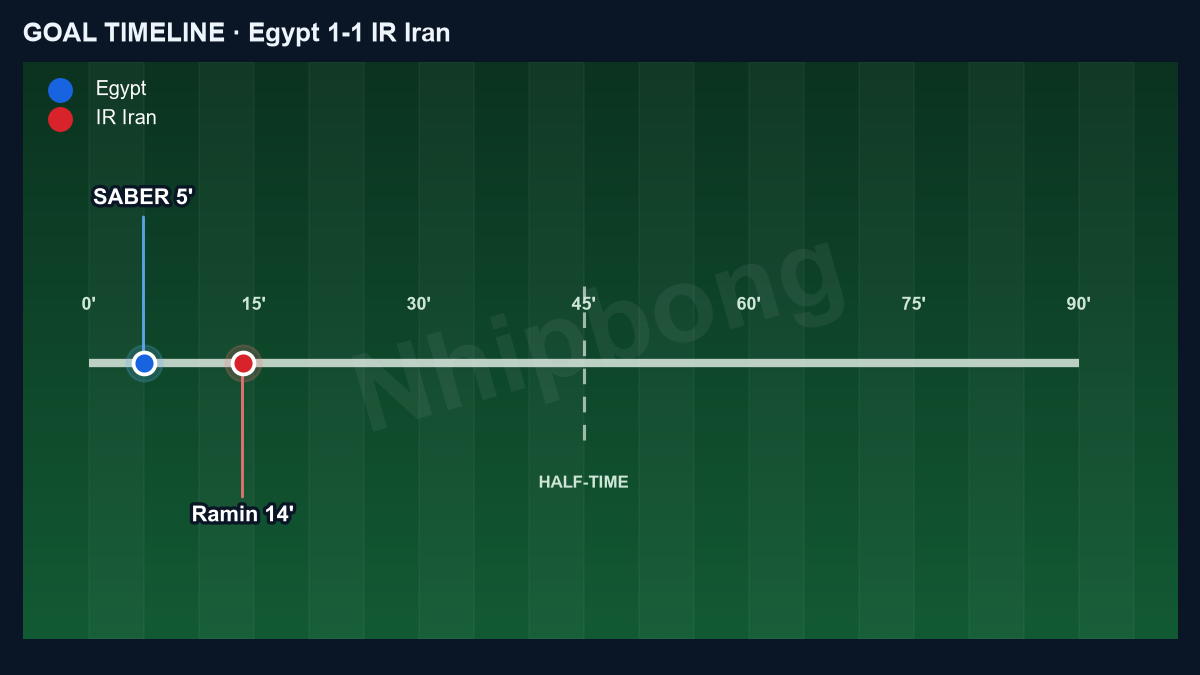
Egypt and Iran shared the points in a 1–1 draw to open their Group G campaign at World Cup 2026 in Seattle. Both goals arrived inside the first 14 minutes: Mahmoud Saber put Egypt ahead as early as the 5th minute before Ramin Rezaeian levelled for Iran in the 14th. The Jarvis supercomputer model predicted Egypt before kickoff with a 39.1% chance of victory, but the draw, which Jarvis ranked right behind it at 36.3%, was the outcome that actually played out.
- Egypt 1–1 Iran, the Group G opener at World Cup 2026 on a neutral field in Seattle.
- Mahmoud Saber opened the scoring for Egypt in the 5th minute, Ramin Rezaeian levelled for Iran in the 14th.
- Jarvis predicted Egypt to win at 39.1%, a draw at 36.3% and an Iran win at 24.5%: the result fell into the second most likely scenario.
- Mohamed Salah started and wore the number 10 shirt to lead the Egypt attack, with Mehdi Taremi spearheading Iran's front line.
- Iran arrived at the tournament amid plenty of off-field upheaval but still claimed a valuable point against a higher rated opponent.
| Outcome | Egypt | Draw | Iran |
|---|---|---|---|
| Jarvis probability | 39.1% | 36.3% | 24.5% |
| Metric | Jarvis forecast |
|---|---|
| Expected total goals | 1.94 |
| Predicted score | 1–0 |
| Chance of 3+ goals | 30.6% |
Head to head: Jarvis prediction vs the actual result
| Category | Prediction (pre-match) | Actual | Correct? |
|---|---|---|---|
| Winner | Egypt (39.1%) | Draw (1–1) | ✗ Off |
| Predicted score | 1–0 | 1–1 | ✗ Off |
| Expected goals | 1.9 goals | 2 goals | ≈ Close |
| Chance of 3+ goals | 30.6% | No | ✓ Right |
Overview: a point shared in Seattle

This Group G World Cup 2026 meeting between Egypt and Iran in Seattle finished 1–1, a result that fairly reflected the tug of war between two national teams rated on a similar level. It was an opening fixture both badly needed points from, and in the end each side walked away with one point in hand.
Before kickoff, the Jarvis supercomputer model laid out its three probabilities: Egypt to win 39.1%, a draw 36.3% and Iran to win 24.5%. That spread showed Jarvis saw this as a pairing very hard to separate, with the gap between the top scenario and the draw amounting to less than three percentage points.
The pre-match context supported that read: Egypt came into the tournament in encouraging form, including a 1–1 draw with Belgium, along with a well organised defence and a solid body of work from African regional qualifying. Iran, by contrast, faced no shortage of disruption in their preparation, from visa problems and having to move their base away from Mexico to the wider upheaval that weighed on the squad's mood.
How it unfolded: two goals inside the opening 14 minutes
The match exploded into life from the very first minutes. As early as the 5th minute, Mahmoud Saber, Egypt's midfielder in the number 21 shirt, delivered the finishing blow to send the North African side 1–0 up. The early goal forced Iran to push forward in search of a response before the game had even settled.
And the response came quickly. In the 14th minute, Ramin Rezaeian, the defender wearing number 23 for Iran, drew things level at 1–1. Within just 14 minutes, the crowd in Seattle had seen both of the match's goals, each side finding the net once.
After that frantic opening, neither team found another goal for the rest of the match. The 1–1 scoreline held, a fitting outcome for a game in which both had their own moments but neither could do enough to create any separation.
Against the Jarvis prediction: wrong label, right nature
Judged purely on the 1X2 label, Jarvis's prediction missed: the model made an Egypt win its most likely scenario at 39.1%, while the actual result was a draw. For anyone looking only at the top pick, this counts as a forecast that fell short.
But the probability picture tells a fuller story. The draw was valued by Jarvis at 36.3%, the second highest and trailing the Egypt win by less than three percentage points. In other words, the model accurately identified this as a coin-flip pairing between two sides of the same class, where a draw was always the lurking outcome.
The clearest plus for Jarvis lies on the other side: the Iran win probability was just 24.5%, the lowest of the three scenarios, and Iran indeed could not win despite their early equaliser. Add in the head to head history tilting toward Egypt, and the way the model placed Egypt above Iran yet packed so much probability onto the draw was a reading closely matched to what happened on the pitch.
The starting lineups of both teams
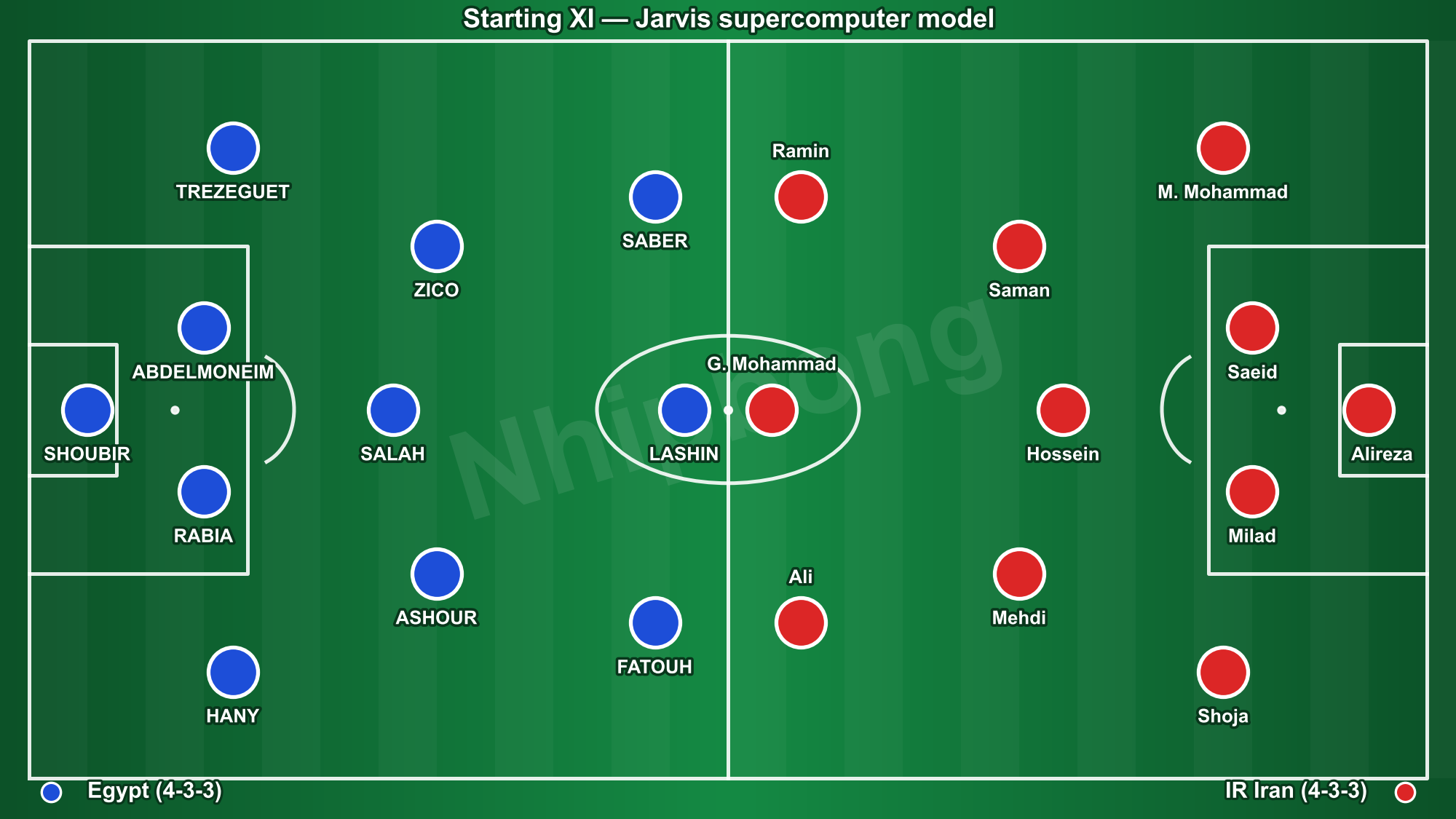
Egypt started with goalkeeper Mostafa Shoubir (23) between the posts and a back four of Mohamed Hany (3), Ramy Rabia (5), Mohamed Abdelmoneim (6) and Ahmed Fatouh (13). The midfield featured Emam Ashour (8), Mostafa Zico (11), Mohanad Lashin (17) and Mahmoud Saber (21), who went on to score his side's only goal. Up front, captain Mohamed Salah (10) partnered Trezeguet (7).
Iran set up with Alireza Beiranvand (1) in goal, and in front of him a crowded defence of Shoja Khalilzadeh (4), Milad Mohammadi (5), Hossein Kanani (13), Ali Nemati (19) and Ramin Rezaeian (23), with Rezaeian himself the man who scored the equaliser. The midfield had Saeid Ezatolahi (6), Mohammad Mohebbi (8), Saman Ghoddos (14) and Mohammad Ghorbani (21), while Mehdi Taremi (9) led the line as the most advanced man.
Notably, the two goalscorers in this match were not among the most talked about names before kickoff: a number 21 midfielder for Egypt and a number 23 defender for Iran, rather than Salah or Taremi, were the ones who settled the score.
You can find more standout fixtures in our daily predictions hub.
Conclusion: a first point and a test for both
The 1–1 draw earned each team one point from the opening round of Group G. For Egypt, it was a slightly frustrating result given they were rated higher, led first and had Mohamed Salah in the starting eleven. For Iran, taking a point off an opponent seen as the favourite, against a backdrop of heavily disrupted preparation, was a very creditable result.
As for the model, this was a match that showed the value of reading a prediction as a probability distribution rather than a single result label. Jarvis did not name the winner correctly, simply because the match had no winner, but placing the draw at 36.3% right next to the leading option showed the model had accurately quantified how balanced this pairing was well before kickoff.
Frequently asked questions
What was the result of Egypt vs Iran?
The final score was Egypt 1–1 Iran. The teams shared the points.
Did the Jarvis supercomputer model predict this match correctly?
Before kick-off, Jarvis called a 1–0 scoreline and predicted Egypt to win at 39.1%. The actual result was 1–1, which differed from the prediction.
How many goals were scored in Egypt vs Iran?
2 goals in total. Jarvis had expected around 1,94 goals before the match.
Who scored in this match?
Egypt: Mahmoud Saber (5). Iran: Ramin Rezaeian (14).