


Brazil 2–1 Japan: how the Jarvis supercomputer's prediction held up
Nhipbong Analytics
Jarvis prediction desk

Brazil came from behind to beat Japan 2–1 in the World Cup 2026 round of 32 in Houston, and had to wait until the 90+6th minute for Gabriel Martinelli's clinching goal. The Jarvis supercomputer model had rated Brazil to win with a 56.9% probability before kickoff, and the Selecao, despite falling behind, answered exactly as that number suggested. But the way Japan troubled Brazil for almost the entire 90 minutes showed that the remaining 43.1% was anything but a decorative figure.
- Brazil came from behind to beat Japan 2–1 in the World Cup 2026 round of 32, played in Houston on 29 June.
- Kaishu Sano opened the scoring for Japan in the 29th minute, Casemiro equalised in the 55th, and Gabriel Martinelli settled it in the 90+6th.
- Jarvis predicted before kickoff: Brazil to win 56.9%, a draw at 24.5%, Japan to win 18.6%. The result landed squarely in the most likely outcome.
- Japan arrived at this stage on an unbeaten run, including a 3–2 friendly win over Brazil in 2025, so their 18.6% share was far from low without reason.
- Martinelli was not in the starting eleven, yet he was the man who scored the decisive goal in stoppage time.
| Outcome | Brazil | Draw | Japan |
|---|---|---|---|
| Jarvis probability | 56.9% | 24.5% | 18.6% |
| Metric | Jarvis forecast |
|---|---|
| Expected total goals | 2.5 |
| Predicted score | 2–0 |
| Chance of 3+ goals | 45.6% |
Head to head: Jarvis prediction vs the actual result
| Category | Prediction (pre-match) | Actual | Correct? |
|---|---|---|---|
| Winner | Brazil (56.9%) | Brazil (2–1) | ✓ Right |
| Predicted score | 2–0 | 2–1 | ✗ Off |
| Expected goals | 2.5 goals | 3 goals | ≈ Close |
| Chance of 3+ goals | 45.6% | yes | ✗ Off |
Brazil escape in stoppage time, Jarvis keeps its word

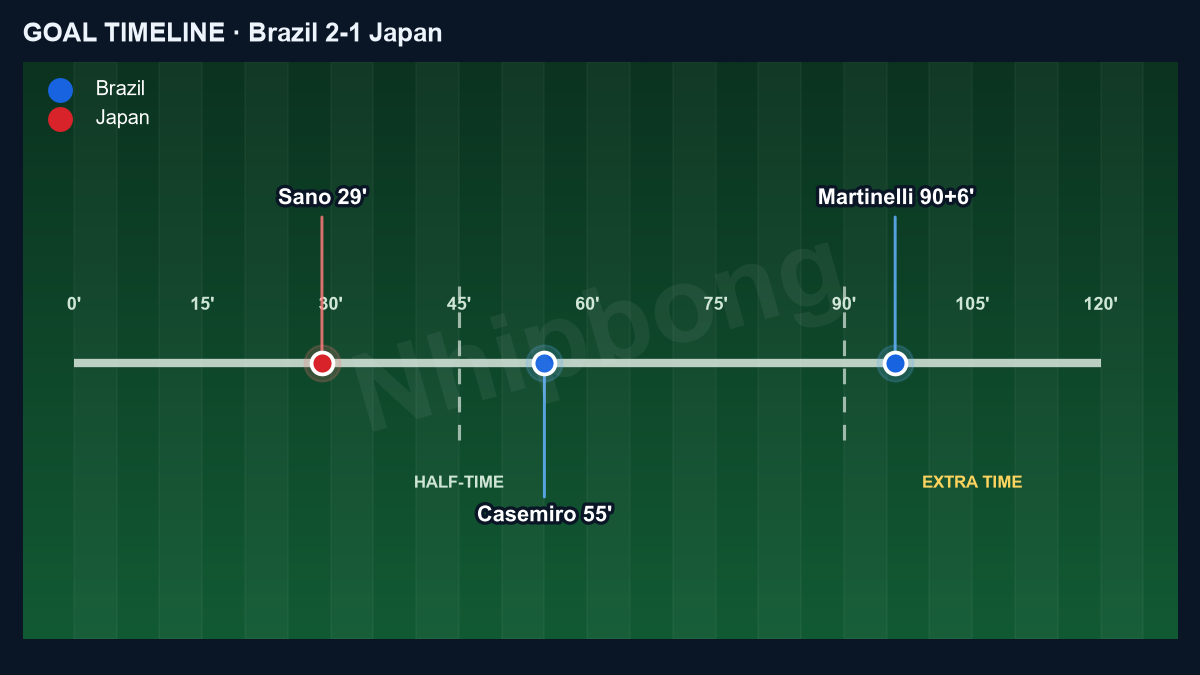
The World Cup 2026 round of 32 tie in Houston on 29 June ended in a 2–1 win for Brazil, but it was a victory that demanded sweat all the way to the 90+6th minute. Japan led from midway through the first half, forcing the five-time world champions to chase for most of the contest, and only folded once the referee had already glanced at the added time on the clock.
Before kickoff, the Jarvis supercomputer model laid out its set of probabilities: Brazil to win 56.9%, a draw at 24.5%, Japan to win 18.6%. The final result fell squarely into the most likely outcome, meaning Jarvis called it correctly. Yet the 43.1% assigned to the other two scenarios was vividly illustrated on the pitch: at times the match sat very close to a draw, and even close to a Japan win.
How it unfolded: Sano strikes first, Casemiro and Martinelli reply
In the 29th minute, Kaishu Sano, the midfielder wearing Japan's number 24, put the Asian side 1–0 ahead. That goal captured exactly the image Japan brought to the tournament: organised pressing and the ability to punish an opponent in a single moment. Brazil, having come through a group stage that was not truly convincing, were once again pushed into proving their character.
In the second half, experience spoke. In the 55th minute, Casemiro, the midfield leader in the number 5 shirt, drew the Selecao level at 1–1. The match then hung in the balance right until the closing seconds, when Gabriel Martinelli, a name absent from Brazil's starting eleven, scored in the 90+6th minute to seal it 2–1. A classic comeback script: behind early, level after the interval, then finished off with the opponent just a few breaths away from extra time.
Measuring up the Jarvis prediction: right outcome, and right about the difficulty

On the result alone, Jarvis scored full marks: the Brazil win at 56.9% was the model's number one call, and that is exactly what happened. What is more telling lies in the structure of the probability set. Jarvis never treated this as a one-sided match, since adding the 24.5% draw and Japan's 18.6% to make 43.1% meant the model had warned in advance that Brazil could well be given a hard time.
The basis for that caution sat in the input data itself: Japan came to Houston on an unbeaten run, including a 3–2 friendly win over Brazil in 2025, along with their weapons of high pressing, set pieces and effective counterattacks. Brazil, for all their superior squad depth and five world titles, had just been through an up and down group stage. The way it actually played out, with Japan leading until the 55th minute and only losing in the sixth minute of stoppage time, shows how closely the Jarvis probability distribution described this match.
Starting lineups: Brazil's stars, Japan's discipline
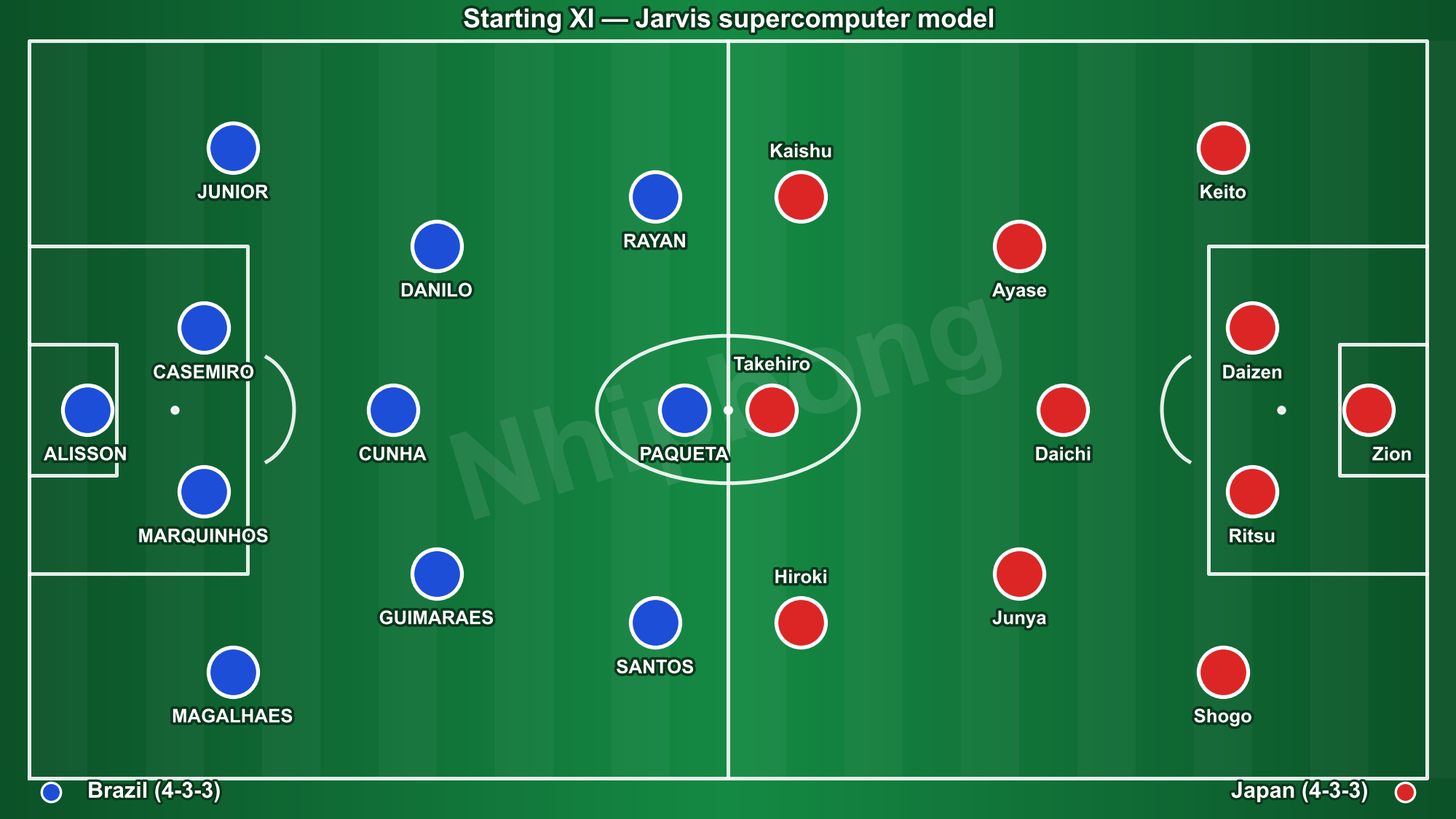
Brazil took the field with Alisson guarding the goal; a back four of Danilo, Marquinhos, Gabriel Magalhaes and Douglas Santos; a midfield of Casemiro, Bruno Guimaraes and Lucas Paqueta; and an attack of Vinicius Junior, Matheus Cunha and Rayan. Notably, the hero Martinelli did not start, proof of the squad depth that Jarvis had factored into the Selecao's win probability.
On the other side, Japan named Zion Suzuki in goal, a defence of Shogo Taniguchi, Hiroki Ito and Takehiro Tomiyasu, a crowded midfield of Kaishu Sano, Daichi Kamada, Keito Nakamura, Ritsu Doan, Junya Ito and Daizen Maeda, and Ayase Ueda leading the line. It was precisely this midfield-heavy structure that let Japan choke Brazil's build-up rhythm in the first half, and Sano, one of those midfielders, was the man who opened the scoring.
You can find more standout fixtures in our daily predictions hub.
Conclusion: the champions' resolve and the value of a model that knows how to doubt
Brazil advance, exactly as Jarvis's most likely outcome had it, but the road to this 2–1 win is a reminder that in the World Cup knockout rounds, class has to come with grit. Pegged back by a Japan side playing razor-sharp counterattacks, the Selecao needed Casemiro's equaliser and Martinelli's 90+6th minute moment to avoid dragging the match into danger.
For Japan, a narrow defeat to a title contender closes out a World Cup they leave with their heads held high. And for those who follow the model, this match is a fine example of how to read a prediction: Jarvis picked Brazil, but also made clear that nearly half the likelihood belonged to another scenario. The pitch played out both halves of that statement.
Frequently asked questions
What was the result of Brazil vs Japan?
The final score was Brazil 2–1 Japan. Brazil won the match.
Did the Jarvis supercomputer model predict this match correctly?
Before kick-off, Jarvis called a 2–0 scoreline and predicted Brazil to win at 56.9%. The actual result was 2–1, so Jarvis called the winner correctly.
How many goals were scored in Brazil vs Japan?
3 goals in total. Jarvis had expected around 2,5 goals before the match.
Who scored in this match?
Brazil: Casemiro (55'), Gabriel Martinelli (90+6'); Japan: Kaishu Sano (29').