


Mexico 2–0 Ecuador: how the Jarvis supercomputer's prediction held up
Nhipbong Analytics
Jarvis prediction desk

The World Cup meeting between Mexico and Ecuador closed out with a 2–0 win for Mexico. Before kickoff, the Jarvis supercomputer model had Mexico to win at 42%, a draw at 36%, and Ecuador to win at 23%, alongside a predicted score of 1–0 and an expected total of 1.9442 goals. This piece checks all of those numbers against what actually happened on the pitch.
- Mexico beat Ecuador 2–0, keeping a clean sheet for the full match.
- Before kickoff, Jarvis had Mexico at 42%, the draw at 36%, and Ecuador at 23%, meaning a Mexico win was the highest-rated outcome of the three.
- The pre-match predicted score was 1–0; the real result ran one notch hotter at 2–0.
- The expected total of 1.9442 goals landed almost exactly on the match's actual two goals.
- The model had tagged this fixture with LOW confidence beforehand, marking it as one it viewed as carrying more uncertainty than usual.
| Outcome | Mexico | Draw | Ecuador |
|---|---|---|---|
| Jarvis probability | 42% | 36% | 23% |
| Metric | Jarvis forecast |
|---|---|
| Expected total goals | 1.94 |
| Predicted score | 1-0 |
| Chance of 3+ goals | 30.8% |
Head to head: Jarvis prediction vs the actual result
| Category | Prediction (pre-match) | Actual | Correct? |
|---|---|---|---|
| Winner | Mexico (42%) | Mexico (2–0) | ✓ Right |
| Predicted score | 1–0 | 2–0 | ✗ Off |
| Expected total goals | 1.9 goals | 2 goals | ≈ Close |
| Chance of 3+ goals | 30.8% | No | ✓ Right |
How the Match Played Out
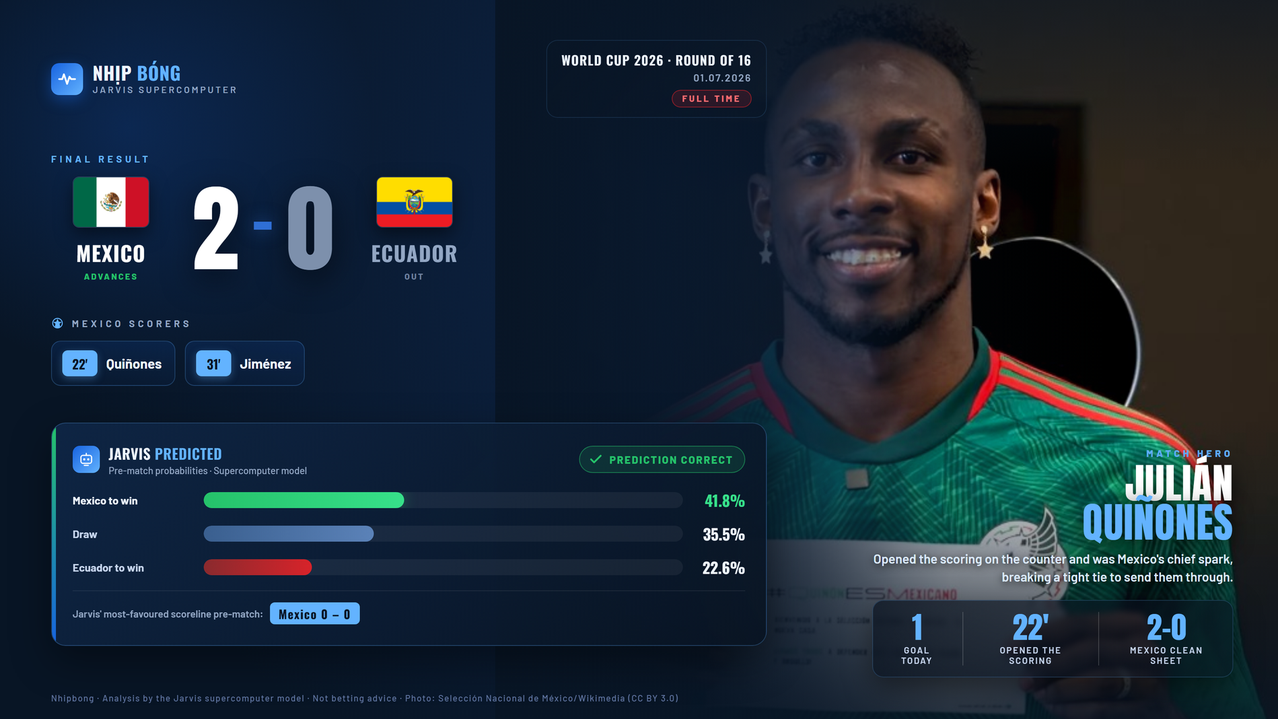
The World Cup match between Mexico and Ecuador ended in a clear 2–0 win for Mexico. There is nothing ambiguous about who went through to the round of 16: Mexico scored twice and kept a clean sheet, while Ecuador never found the net across the full match.
Mexico settled it inside the first half: Julián Quiñones opened the scoring in the 22nd minute from a Roberto Alvarado through ball, and nine minutes later he turned provider for Raúl Jiménez to double the lead. From the 31st minute on, the job was to protect the clean sheet, and Mexico did exactly that to the final whistle.
A 2–0 win with a clean sheet usually points to a side that controlled the moments that mattered and never let its opponent grab a consolation goal. The match numbers bear that out: Ecuador had more of the ball (57.2%) and won 8 corners, yet only 1 of their 7 attempts hit the target, while Mexico got 15 shots away with just 42.8% of possession. Ecuador also finished with ten men after Piero Hincapié was sent off in stoppage time (90+5).
Jarvis Checked Against the Final Result

Before kickoff, the Jarvis supercomputer model split this match into three fairly closely weighted scenarios: Mexico to win at 42%, a draw at 36%, and Ecuador to win at 23%. None of the three cleared the halfway mark, but a Mexico win carried the highest number of the group. The 2–0 result therefore landed on the scenario the model weighted most heavily, even though the gap between 42% and 36% was a thin one.
On the scoreline itself, Jarvis never claimed to be naming the single most likely result outright, but instead put forward a predicted score of 1–0 tilted slightly toward Mexico, an anchor point meant to capture the model's broader lean. The match actually finished 2–0: the same direction as that anchor, just one notch hotter. In other words, the model read the stronger side correctly, it was simply that Mexico won by more than the margin the pre-match line had anchored to.
The clearest match of all sits in the total goal count. Jarvis projected an expected 1.9442 goals, and the real total came in at exactly two, a gap of less than a tenth of a goal. Looked at purely through overall goal volume, the forecast and the result sit almost directly on top of each other.
The last figure worth checking is the chance of three or more goals, which Jarvis had set at 31%, meaning the under-three-goals group carried the larger share at 69%. The match settled at two goals, landing squarely in the group the model had viewed as more likely before kickoff.
Directionally Right, But Not a Guarantee


What is easy to miss when a forecast lands is that Jarvis itself was never confident about this one. The model tagged it with LOW confidence, which is its own way of flagging a fixture as hard to read and carrying real uncertainty, rather than a lopsided call. Three closely bunched scenarios say the same thing in a different way: through the model's lens, the gap between these two sides was thin. So the top-rated scenario coming through should not be read as Jarvis being proven right in some absolute sense, just as the heaviest-weighted number showing up on this single draw. A single match is one draw from a probability distribution; if Ecuador's 23% scenario had played out instead, that would not have made the model wrong either.
The most interesting part is not right or wrong, it is that the model was directionally right but off on intensity. Jarvis anchored to a tight, low-scoring match with a predicted score of 1–0. In reality Mexico scored twice, one more than that anchor point, while the match's overall goal total landed almost exactly on the expectation. Put those two details together and the gap sits in Mexico concentrating all of the match's scoring in its own favor, rather than the goals splitting more evenly across both sides, which an expected total near two goals could just as easily have modeled. Ecuador had more of the ball but still finished empty-handed.
Read the right way, a result that matches the top-rated scenario in a LOW-confidence fixture should count as one data point, not proof the model always calls it correctly. Jarvis's value is not in any single correct call, it is in being upfront about its own degree of certainty beforehand, so readers know which matches to trust more and which to treat with more caution. This one belonged to the second group, and a 2–0 scoreline does not change that.
Data Sources and Notes
Every probability, predicted score, expected-goal total, and goal-threshold figure referenced in this piece comes from the Jarvis supercomputer model, calculated before the Mexico vs Ecuador match kicked off. The actual 2–0 scoreline in Mexico's favor was recorded once the match had finished. The scorers and goal times (Quiñones in the 22nd minute, Jiménez in the 31st), along with the possession, shot and card figures, come from the match data.
This is statistical analysis, not betting advice.
Frequently asked questions
What was the final score between Mexico and Ecuador?
Mexico beat Ecuador 2–0.
Which side did the Jarvis model rate higher before kickoff?
Jarvis had Mexico at 42%, the draw at 36%, and Ecuador at 23%, making Mexico the highest-rated scenario of the three, though still short of a majority.
Did the actual score match Jarvis's pre-match predicted score?
The pre-match predicted score was 1–0 in Mexico's favor, while the actual result was 2–0, the same direction but one notch hotter than what the model had anchored to.
Who scored in the Mexico vs Ecuador match?
Julián Quiñones opened the scoring in the 22nd minute, then set up Raúl Jiménez for the second in the 31st, both for Mexico.
What confidence level did Jarvis assign to this match?
The model tagged this fixture with LOW confidence before kickoff, meaning Jarvis itself viewed it as carrying more uncertainty than usual.