


Paraguay 0–1 France: how the Jarvis supercomputer's prediction held up
Nhipbong Analytics
Jarvis prediction desk

France closed out the World Cup round of 16 with a 0–1 win over Paraguay. Before kick-off, the Jarvis supercomputer model predicted France at 81%, and the result went the way it pointed. But when I place the forecast next to the actual scoreline, a few gaps are worth dissecting: the game had far fewer goals than expected, and both the model and the result reminded me that a high percentage is never a cast-iron promise.
- Result: Paraguay 0–1 France, World Cup round of 16.
- Jarvis before kick-off: France 81%, draw 13%, Paraguay 5%. The winner went the way it pointed.
- The model's single predicted score was 0–2; the actual result was 0–1, with France still winning and keeping a clean sheet.
- The actual goal total (1) came in below the expected 2.87; the scenario of three goals or more (55%) did not happen.
- The model filed its confidence as low, matching a narrow win.
- The only goal: Kylian Mbappé's penalty on 70 minutes.
| Outcome | Paraguay | Draw | France |
|---|---|---|---|
| Jarvis probability | 5% | 13% | 81% |
| Metric | Jarvis forecast |
|---|---|
| Expected total goals | 2.87 |
| Predicted score | 0-2 |
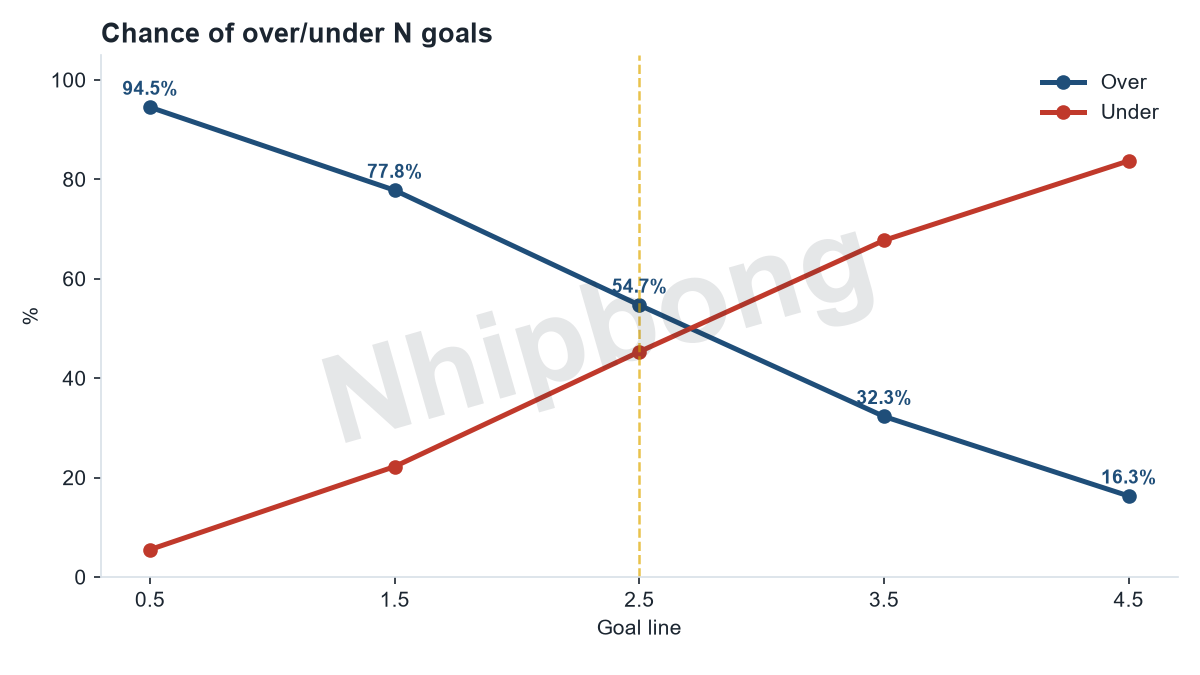
| Chance of 3+ goals | 54.7% |
Head to head: Jarvis prediction vs the actual result
| Category | Prediction (pre-match) | Actual | Correct? |
|---|---|---|---|
| Winner | France (81%) | France (0–1) | ✓ Right |
| Predicted score | 0–2 | 0–1 | ✗ Off |
| Expected total goals | 2.9 goals | 1 goal | ✗ Off |
| Chance of 3+ goals | 54.7% | no | ✗ Off |
How it unfolded: a single goal settled it
France came through against Paraguay by a 0–1 scoreline in the World Cup round of 16. The only goal came on 70 minutes, when Kylian Mbappé converted a penalty.
A single goal was enough to decide the entire contest. France, rated well above their opponents before kick-off, took the narrowest of wins and kept a clean sheet. Paraguay ended the match without managing a goal of their own. The scoreline itself hints at the character of the game: few goals, a slender margin, exactly the sort of cagey, calculated knockout tie you would expect.
Talking points: a clean sheet and a low-scoring game
The first talking point is France's clean sheet. Winning 0–1 means the favoured side both found a goal and conceded none, a tidy result in a knockout round where every error can be punished dearly.
The second lies in the goal count. The whole match produced just one strike, making this a low-scoring affair. For a pairing the model expected to yield close to three goals, seeing only one scored is the most notable detail in how it played out.
The third belongs to Paraguay. Rated at just a 5% chance of winning, they did not collapse; they lost by a single goal rather than being brushed aside. That slender margin is what makes the match worth a second look, even if the final outcome still tilted to the stronger side.
Jarvis compared: the pre-match forecast against the actual result


This is the part I want to dwell on longest, because holding the forecast up against reality is where you read off where the model got it right and where it fell short.
First, the winner: Jarvis had France at 81%, the draw at 13% and Paraguay at just 5%. The result was a France win. On the single most important category, the forecast pointed the right way. The clearly higher-rated side went through, while both the draw and a Paraguay upset failed to materialise.
Second, the scoreline. The model flagged 0–2 as the single most likely result, while the reality was 0–1. A one-goal difference, but a difference that still tells the same story: France won, France kept a clean sheet, Paraguay did not score. The miss is in the margin, not in the nature of the result.
Third, and this is the most striking gap, the goal total. Jarvis expected 2.87 goals for this match, and the reality was exactly 1. The game produced far fewer goals than the model pictured. Alongside it, the chance of three goals or more was set at 55%, more than half, yet that scenario never came to pass. It was the other 45%, the branch of under three goals, that actually played out.
Fourth, the confidence. From the start, Jarvis attached a low confidence rating to this match. Looking back, that label rings true: a tight 0–1 win, settled by a single moment, is exactly the sort of game the model had quietly warned would be hard to pin down in its details.
The tactical angle: reading the match through the probability frame


I read the game through the probability frame itself, set against its one decisive moment: Mbappé's penalty on 70 minutes.
The most telling clue is the gap between the 2.87 goals expected and the 1 goal that actually arrived. A game with only one strike, and that one from the penalty spot, is usually a tense one, short on clear chances or wasteful in front of goal, with the underdog holding its shape far better than the 81% against 5% split would suggest. Paraguay, clearly rated the lesser side, forced France to settle for a minimal win rather than a rout.
Put another way, the result landed in the branch where the stronger side wins, but wins the hard way. The direction of the outcome matched what was expected of the favoured team, while the character of the game leaned toward a low-scoring script, which the actual goal total spoke for.
What the probability means: 81% is not a promise
There is one thing I always want to remind readers: 81% is not a promise. It means that if a match like this were played out many times over, France would win roughly eight times in ten, with the other two going to a draw or an upset. This time France did indeed win, but that number never guaranteed a comfortable margin or a one-sided game.
That is clearest in the goal total. The chance of three goals or more was set at 55%, almost a balancing line. When a probability only just clears the halfway mark, it not happening is entirely normal, not a sign the model was wrong. And here, the 45% had its say.
On top of that, Jarvis filed its own confidence as low for this match. That is the model being honest that it was unsure, and a tight 0–1 result is a vivid illustration of that caution. Probability is a tool for understanding what is likely, not a key that unlocks the result in advance.
You can find more standout fixtures in our daily predictions hub.
Sources and a note
Every probability, expected scoreline and confidence level in this piece comes from the Jarvis supercomputer model, locked in before the match and left untouched so it can be measured against the actual result. The final score is post-match data, and the scorer and goal time (Mbappé, penalty on 70 minutes) come from the match record.
The aim of this article is to look back at where the model read the game right and where it drifted, so that readers understand how a forecast works, not to encourage any form of wagering. This is statistical analysis, not betting advice.
Frequently asked questions
What was the final result of Paraguay vs France?
France beat Paraguay 0–1 in the World Cup round of 16. It was a minimal win: France scored once and kept a clean sheet, while Paraguay could not find a goal.
How did the Jarvis model forecast this match, and was it right?
Before the match, Jarvis had France at 81%, the draw at 13% and Paraguay at 5%. On the winner, the forecast was right, because France won. The single predicted score the model gave was 0–2, while the reality was 0–1, a one-goal difference but the same overall story.
Who scored for France?
Kylian Mbappé scored France's only goal from the penalty spot on 70 minutes.
Why did the match have fewer goals than forecast?
Jarvis expected 2.87 goals and put the chance of three or more at 55%, yet the whole match produced just 1. That points to a tighter game with fewer chances than the model pictured, and the 45% probability for a low-scoring result is the branch that played out.
Does an 81% chance for France mean a certain win?
No. 81% means that if the match were played many times over, France would win about eight times in ten, with the rest going to a draw or an upset. The model also filed its own confidence as low for this match, so a narrow 0–1 result was well within expectations.