


France vs England prediction: the Jarvis supercomputer's verdict
Nhipbong Analytics
Jarvis prediction desk

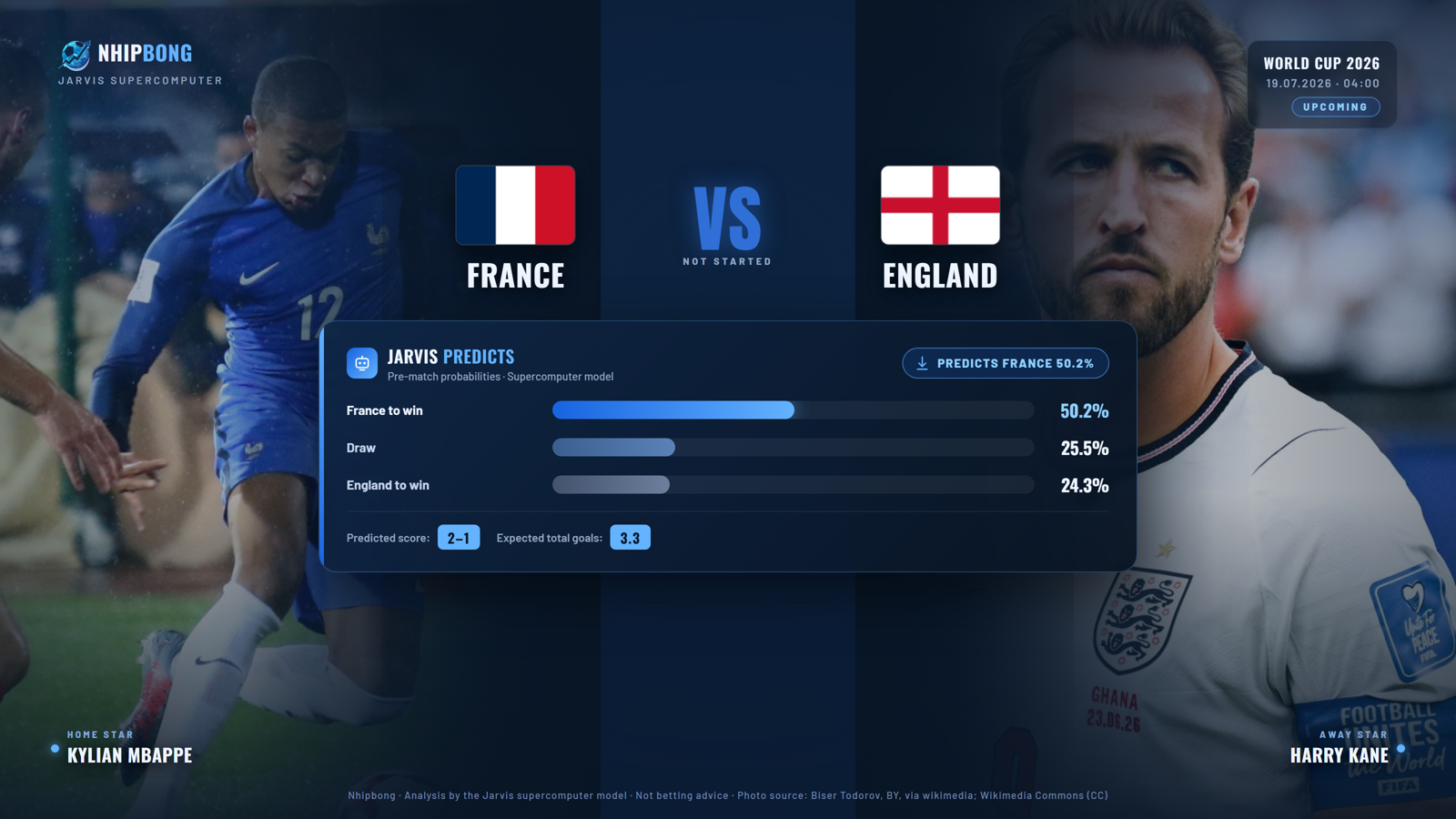
The Jarvis supercomputer model gives France a 50% chance of beating England, well clear of the 24% assigned to their opponents, in this World Cup fixture. Both sides have just been through the exact same pattern: four consecutive wins undone by a slip in their very last outing, but the gap between them sits in defense, not attack.
- Jarvis rates France at 50% to win, a draw at 25%, England at 24%.
- The predicted scoreline the model points to: 2–1.
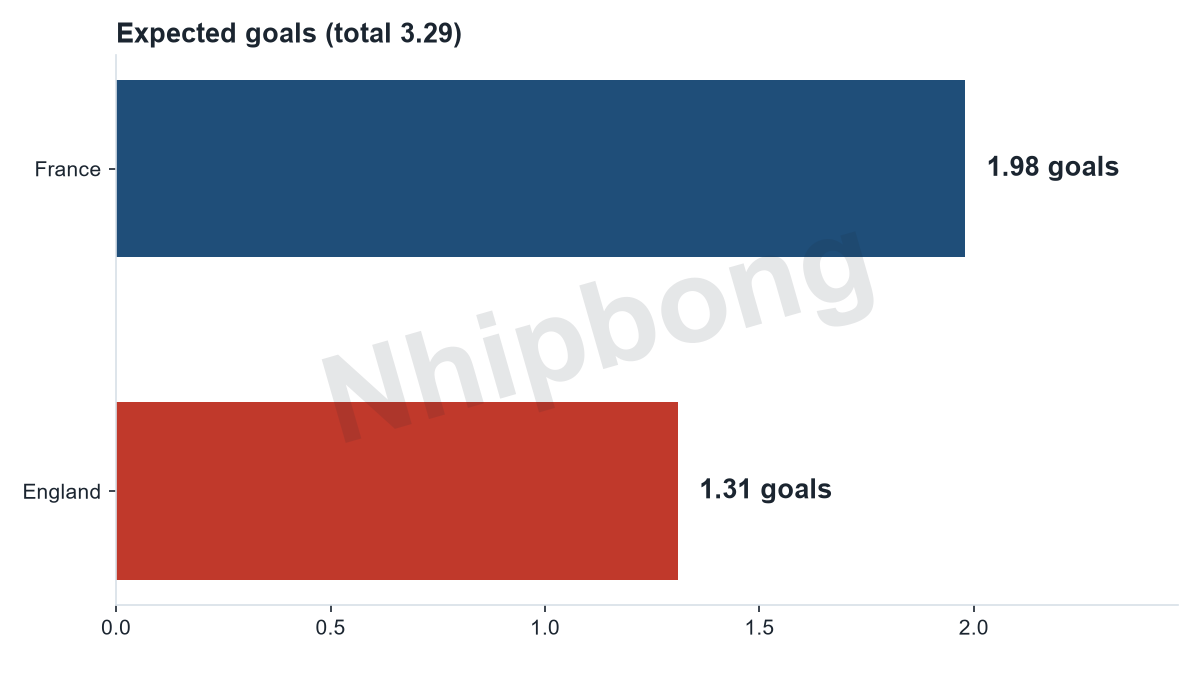
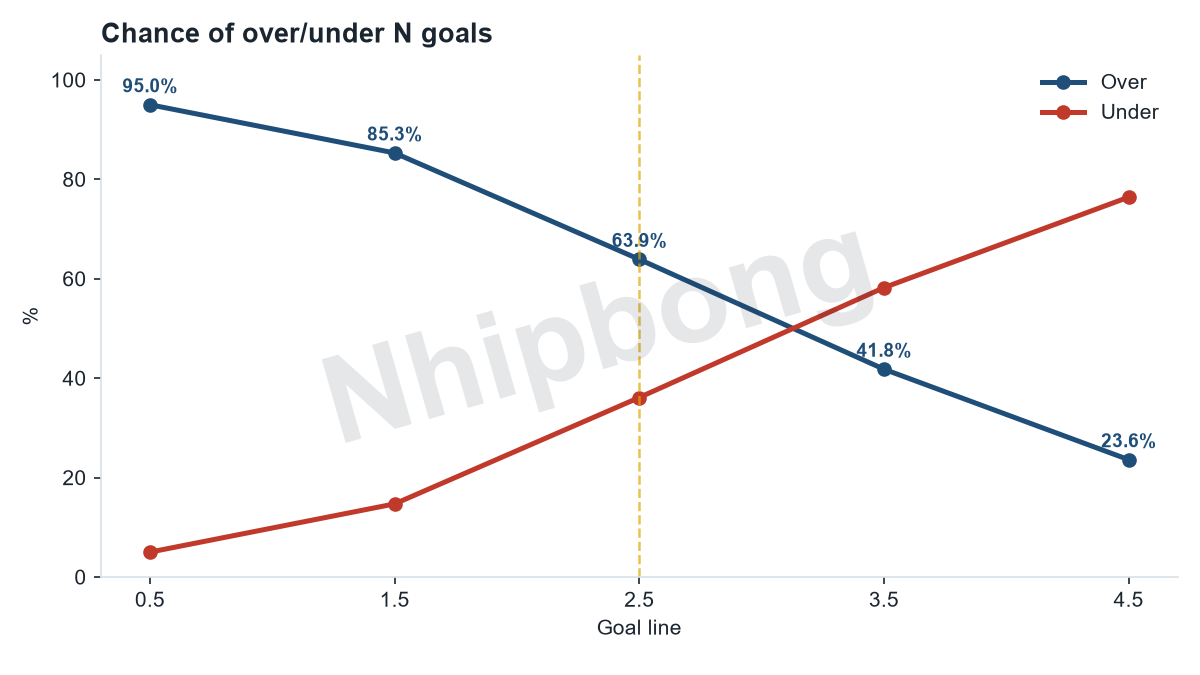
- Combined expected goals for the match: 3.2663, with a 63% chance of 3 or more goals.
- Prediction confidence: LOW.
- The last World Cup meeting between these two came in 2022, when France won 2–1.
| Outcome | France | Draw | England |
|---|---|---|---|
| Jarvis probability | 48.1% | 26.3% | 25.6% |
| Metric | Jarvis forecast |
|---|---|
| Expected total goals | 3.17 |
| Predicted score | 2–1 |
| Chance of 3+ goals | 61.4% |
| Confidence | Medium |
Two identical form lines, so why does Jarvis split 50% against 24%
There is a paradox sitting right on the surface of this matchup. Looking only at the results column, France and England are carbon copies of each other: loss-win-win-win-win across their last five World Cup matches, 10 goals scored each, and both freshly beaten in their most recent outing. The two sides are symmetrical enough that you would expect the probabilities to be split down the middle.
But the Jarvis supercomputer model does not split it evenly. France is rated at 50% to win, a draw sits at 25%, and England gets only 24%. That means somewhere beneath the identical surface results, there is a detail heavy enough to tilt the balance twice as far toward one side. The rest of this piece goes looking for that detail, and it is not the goals scored column.
LOW confidence: the model is telling you it is not fully sure
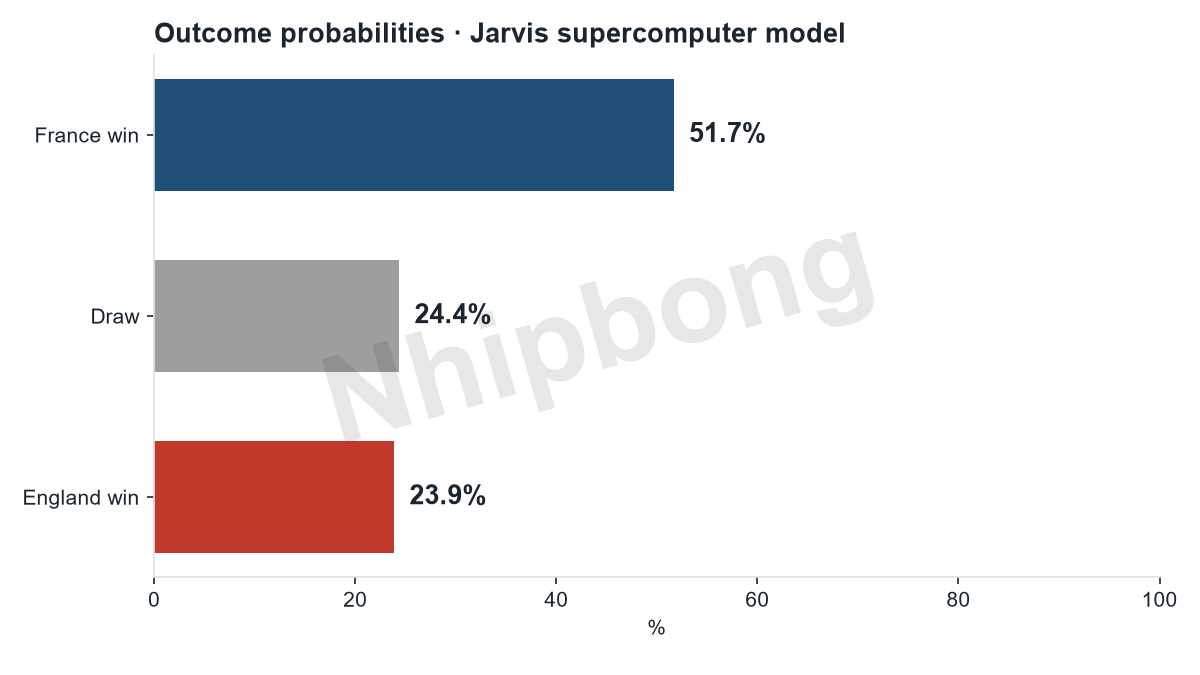
Before digging into the data, there is a flag worth putting on the table first: Jarvis rates the confidence of this prediction as LOW, below its usual level. This is the model grading itself, and it is acknowledging that the spread in the input data for this particular matchup is wider than normal.
That lines up with what I found above. When two teams walk in with form profiles that match line for line, every scenario has room to happen, and France's 50% figure should be read as the model's lean at the moment it ran the numbers, not a verdict carved in stone. The 24% given to England is still very much a door left open.
France's form: an attacking curve that trends downward as the opposition gets tougher
Lining up France's last five matches on a timeline from oldest to newest, I see a curve that trends broadly downward. On June 26, France opened with a 4–1 win over Norway. On June 30, a 3–0 win over Sweden. On July 4, only a 1–0 win over Paraguay. On July 9, a 2–0 win over Morocco. Then on July 14, a 0–2 loss to Spain.
France's scoring output goes from 4, down to 3, down to 1, up to 2, then to 0. The tougher the opponent got, the thinner France's winning margin became, until it disappeared entirely against Spain. Here is the point I want to underline: France has not gone off the boil, France has been squeezed progressively harder by the quality of the opposition. And England, on paper, is not a Norway or a Paraguay.
The bright spot in this run sits on the other side of the ball. In the three matches in the middle of the streak, against Sweden, Paraguay and Morocco, France shut the door completely: 3–0, 1–0, 2–0. Even as the attack thinned out, the defense did not concede a single goal.
England's form: three straight wins by a single goal

England's run reads well on paper, but look closely at the margins and it tells a different story. On June 27, England beat Panama 2–0. On July 1, a 2–1 win over DR Congo. On July 6, a 3–2 win over Mexico. On July 11, a 2–1 win over Norway. On July 15, a 1–2 loss to Argentina.
Across those four straight wins, England never won by more than a single goal after the Panama match. 2–1, 3–2, 2–1, three wins by exactly one goal, meaning three times England stood just one moment away from being pulled level. England's position has been as thin as a tightrope, and against Argentina the rope snapped: a 1–2 loss, still by the same one-goal margin.
In other words, England's winning streak has not been a run of dominance, it has been a run of survival. Four times walking the wire and staying balanced, and on the fifth attempt, the fall.
France vs England head-to-head: the last meeting also came at a World Cup

Across the last five meetings, France has won three, drawn one and lost one. Most recently, on December 10, 2022, at the World Cup, France won 2–1. Before that, France won a friendly 3–2 on June 13, 2017, while England won a friendly 2–0 on November 17, 2015. Further back came a 1–1 draw at Euro 2012 and a 2–1 France win in a 2010 friendly.
So France has won both of the two most recent meetings, and the latest of them came at a World Cup, the same stage as the match coming up. Four of those five games ended level or with a one-goal margin. The only exception was France's 2–0 defeat in 2015.
The detail tilting the balance: 10 goals scored each, but one side has conceded twice as many as the other
This is where the paradox from the top of this piece gets resolved. Both teams have scored 10 goals in their last five matches, both carry the same loss-win-win-win-win sequence, but France has conceded only 3 goals while England has conceded 6, double the total. Two profiles that look identical up front are split wide apart at the back. For a model that computes probability off goal difference, that gap is more than enough to push 50% to one side and hold 24% on the other.
On top of that sits the head-to-head history: the last time these two sides met was also at a World Cup, and France came away with a 2–1 win. Combine the tighter defensive record with the direct head-to-head edge, and Jarvis arrives at a rating that leans toward France at 50% against 24% for England, with the remaining 25% assigned to a draw.
Defensive record: France kept three straight clean sheets, England managed only one
The clearest read on both teams' strength comes from how often they have kept a clean sheet across these same five matches. France locked the door for three matches in a row in the middle of the streak: 3–0 against Sweden, 1–0 against Paraguay, 2–0 against Morocco. Three straight matches without a single opponent finding the net.
England is a different story entirely. Across five matches, England kept a clean sheet exactly once, in the opening 2–0 win over Panama. In the other four, DR Congo, Mexico, Norway and Argentina all scored against England, without exception. One team knows how to shut opponents out repeatedly, the other has had to pick the ball out of its own net in nearly every match. That is the most concrete difference I can read out of the data, and it points the same way as Jarvis's lean.
The 2–1 scoreline and what the 50% figure really means

The predicted scoreline Jarvis points to for this match is 2–1, alongside a combined expected goals figure of 3.2663 and a 63% chance that the match finishes with 3 or more goals. It is worth being precise here: 2–1 is not the single most probable outcome across the full range of scorelines Jarvis calculates, it is the figure that represents the direction the model is leaning, meaning the higher-rated side winning by a narrow margin in a match that produces plenty of goals.
The 63% figure is also worth pausing on: the model expects an open match rather than a tightly locked one, even though the two most recent meetings between these sides were both decided by a single goal. Paired with the LOW confidence level noted earlier, the 50%–25%–24% split should be read as a lean at the moment the numbers were calculated, not a figure set in stone before kickoff. This is statistical analysis, not betting advice.
Frequently asked questions
Who does Jarvis predict will win the France vs England match?
The Jarvis supercomputer model rates France at 50% to win, well ahead of the 24% given to England, with the remaining 25% assigned to a draw.
Is the 2–1 scoreline the single most likely result Jarvis calculated?
No. 2–1 is the predicted scoreline reflecting the direction the model is leaning, not the single highest-probability outcome across the full range of results Jarvis computed.
Is the France vs England match expected to be high-scoring?
Quite possibly. Jarvis calculates combined expected goals for the match at 3.2663, and rates the chance of the match finishing with 3 or more goals at 63%.
Have France and England met before, and what were the results?
Yes. The most recent meeting was on December 10, 2022 at the World Cup, which France won 2–1. Before that, France won a 2017 friendly 3–2, England won a 2015 friendly 2–0, and the sides drew 1–1 at Euro 2012.
Why is the confidence level for this prediction rated LOW?
Jarvis rates the confidence of this prediction as LOW, meaning the model registered a wider-than-usual spread in the input data for this particular matchup, so the 50%–25%–24% figures should be read as a lean rather than a locked-in outcome.