


France 4–6 England: how the Jarvis supercomputer's prediction held up
Nhipbong Analytics
Jarvis prediction desk

Before kickoff, the Jarvis supercomputer model rated France as the stronger side with a 52% chance to win, while England's chances stood at just 24%, level with the draw scenario. But when the referee blew the final whistle, the scoreboard told the opposite story: England won 6–4 in a match that produced 10 goals in total, a number that blew past every pre-match calculation.
- England beat France 6–4 in a match that produced 10 goals in total, far beyond the Jarvis model's expected total of 3.29 goals.
- Before the match, Jarvis rated France as the stronger side at 52%, while England was given just a 24% chance, level with the draw scenario.
- The model's predicted score leaned toward France 2–1, the exact opposite direction of how the match actually played out.
- Both teams lost their previous match before facing each other: France fell 0–2 to Spain, England fell 1–2 to Argentina.
- A LOW forecast confidence rating had already signalled the possibility of a wide gap between probability and actual result.
| Outcome | France | Draw | England |
|---|---|---|---|
| Jarvis probability | 52% | 24% | 24% |
| Metric | Jarvis forecast |
|---|---|
| Expected total goals | 3.29 |
| Predicted score | 2-1 |
| Chance of 3+ goals | 63.9% |
Head to head: Jarvis prediction vs the actual result
| Category | Prediction (pre-match) | Actual | Correct? |
|---|---|---|---|
| Winner | France (52%) | England (4–6) | ✗ Off |
| Predicted score | 2–1 | 4–6 | ✗ Off |
| Expected total goals | 3.3 goals | 10 goals | ✗ Off |
| Chance of 3+ goals | 63.9% | Yes | ✓ Right |
France 4–6 England: how a 24% chance beat Jarvis's 52% favourite

Before kickoff, the Jarvis supercomputer model rated France as the stronger side with a 52% chance of victory, while a draw and an England win were each rated at 24%. The predicted score the model pointed to leaned narrowly toward France, 2–1. But when the final whistle went, the scoreboard told a completely different story: England won 6–4, turning a scenario given just a 24% chance into reality, while the side the model favoured most, France, lost the very match it was expected to win.
Going back through the pre-match data, one detail stands out immediately: Jarvis itself had already flagged this forecast with LOW confidence, meaning the model recognised this was a hard game to read. The eventual 4–6 scoreline didn't just beat the 2–1 predicted score, it blew past the model's expected total of 3.2919 goals by more than three times over. It's a clear reminder that when a LOW confidence tag shows up, the gap between forecast and reality can turn out to be enormous.
Both coming off a defeat, France and England threw the door wide open

What stands out is that both sides walked into this meeting fresh off a defeat. France had just lost 0–2 to Spain, while England had suffered a 1–2 defeat to Argentina only days earlier. Before those losses, both teams had strung together four straight wins: France beat Morocco 2–0, Paraguay 1–0, Sweden 3–0 and Norway 4–1; England beat Norway 2–1, Mexico 3–2, DR Congo 2–1 and Panama 2–0. That shared pattern, four wins followed by one loss right before this game, shows two teams that had each taken a stumble just before facing each other, and the stumble showed up most clearly at the back: France shipped two goals against Spain, England shipped two against Argentina.
With two defences that had just been exposed lining up against each other, an open game was always on the cards. Ten goals were scored in total, exactly what both teams' recent form had quietly been warning about, even though the model's own expectation sat at just 3.2919 goals.
The turning point: England's attack stayed consistent, France paid for a loose defence


Looking at England's scoring across their last five matches, one goal against Argentina, two against Norway, three against Mexico, two against DR Congo and two against Panama, the England attack shows rare consistency, finding the net in every single one of those games. That consistency multiplied against France, where England scored six to take all three points.
France's attack, by contrast, shows two extremes: capable of exploding for four goals against Norway or three against Sweden, but also capable of going completely silent, as in the 0–2 shutout loss to Spain right before this game. Scoring four against England shows the attack found its rhythm again at the right moment, but conceding six exposed exactly the defensive weakness that had already surfaced against Spain, and that is the turning point that sent the model's favourite home empty handed.
The tactical picture: two attack-minded sides


Looking back at the three most recent meetings between these two sides, goals have never been in short supply when France play England. At the 2022 World Cup, France won 2–1; in a 2017 friendly, France won more emphatically, 3–2; and at Euro 2012, the two sides drew 1–1. Add those three matches together and fans have seen 10 goals across just three meetings, an average of more than three goals a game, already well above the norm for top-level football. What's more, the combined goal tally from those three previous meetings adds up to exactly the same number of goals scored in this match.
What made this game unusual is that neither side chose a cautious, defensive approach despite coming into it off a loss. Both let their players play on the front foot, staying true to the scoring trend that had defined their World Cup runs so far. The result, a 4–6 scoreline, reads as a natural extension of a head-to-head history that already leaned heavily toward goal-heavy football.
Ten goals and a lesson about LOW confidence in football forecasting
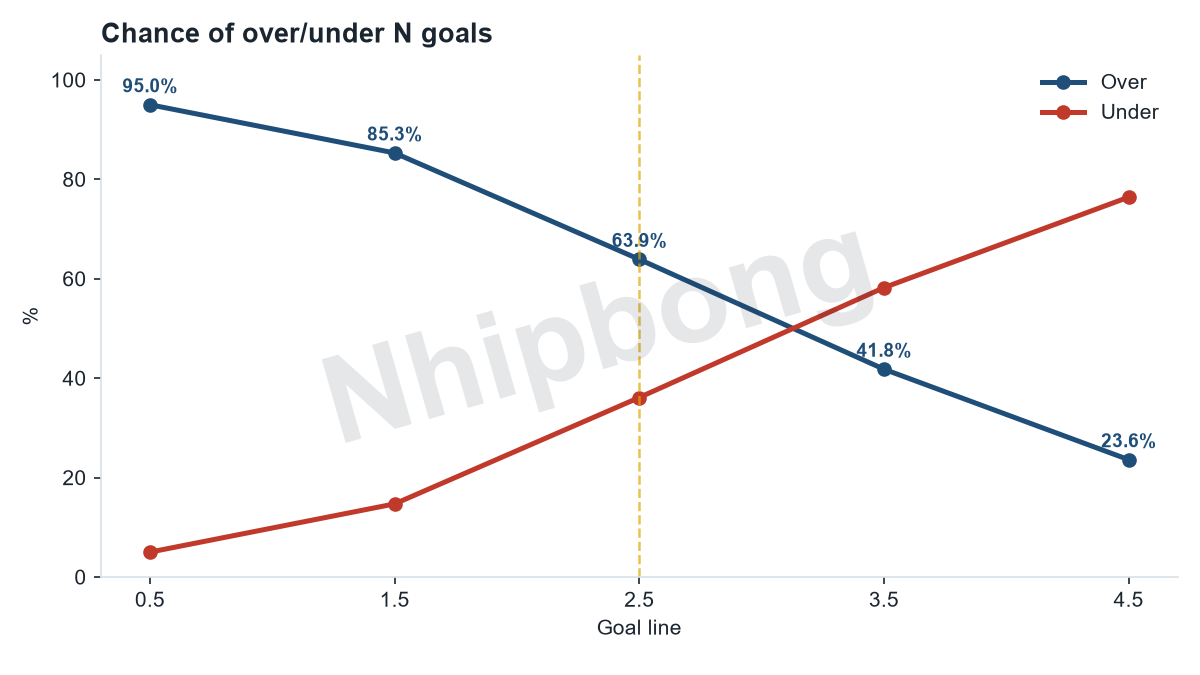
A 52% probability for France against 24% for England never meant France were certain to win, and that's the biggest lesson to take from this result. When a model flags LOW confidence, the gap between the win, draw and loss scenarios usually isn't wide enough to call it a real gulf, and a 24% chance for an England win was still a meaningful probability, one that was entirely capable of playing out in a single match.
The expected total of 3.2919 goals, together with a 64% chance of the match producing three or more goals, got the direction right. This was always going to be a high-scoring game. It's just that the actual total of 10 goals went far beyond anything the model had calculated. It's a reminder that probability measures likelihood across a large set of matches, not a precise forecast for any single game, especially when the underlying data already showed two defences that had just been exposed.
Data sources and a note on reading this analysis
Every probability, predicted score and expected goals total in this piece comes from the Jarvis supercomputer model, calculated before kickoff using recent form and head-to-head data. The five-match form for each side, the historical head-to-head scorelines and the final result of the France vs England match were all checked against the match record. This is statistical analysis, not betting advice.
Frequently asked questions
What was the final score between France and England?
England beat France 6–4, in a match that produced 10 goals in total.
Before kickoff, which team did the Jarvis model favour?
The model rated France as the stronger side with a 52% chance of winning, while a draw and an England win were each rated at 24%, and the predicted score it pointed to was 2–1 in France's favour.
Why did the actual result diverge so far from the forecast?
The pre-match forecast itself carried a LOW confidence tag, meaning the gap between the scenarios wasn't wide enough to call it certain. Both teams had also just conceded two goals in their previous match, France against Spain and England against Argentina, setting the stage for an open, high-scoring game.
What was each team's recent form heading into the match?
Both France and England arrived on a four-match winning streak before suffering a loss in their very last game beforehand, France lost 0–2 to Spain and England lost 1–2 to Argentina.
Does the France vs England head-to-head history lean toward high-scoring games?
Yes. The three most recent meetings between the sides, the 2022 World Cup (France won 2–1), a 2017 friendly (France won 3–2) and Euro 2012 (a 1–1 draw), produced 10 goals combined, showing these matchups have rarely been short on goals.