


Belgium 3–2 Senegal: how the Jarvis supercomputer's prediction held up
Nhipbong Analytics
Jarvis prediction desk

Belgium beat Senegal 3–2 in a five-goal match at the FIFA World Cup. I'm putting that result next to the Jarvis supercomputer model's pre-match forecast to see where the model read it right and where it got caught out.
- Final result: Belgium 3–2 Senegal at the FIFA World Cup.
- Before kickoff, Jarvis rated Belgium at 43%, the draw at 31%, and Senegal at 25%, and the favourite came through.
- The model's predicted score was 2–0, but the real scoreline was 3–2 with 5 goals total, well past the 2.26-goal expected total.
- The pre-match probability of 3 or more goals was just 39%, yet the match produced 5.
- The forecast carried a LOW confidence label from the start, fitting for a result that fell outside the model's central scenario.
| Outcome | Belgium | Draw | Senegal |
|---|---|---|---|
| Jarvis probability | 43% | 31% | 25% |
| Metric | Jarvis forecast |
|---|---|
| Expected total goals | 2.26 |
| Predicted score | 2-0 |
| Chance of 3+ goals | 39.3% |
Head to head: Jarvis prediction vs the actual result
| Category | Prediction (pre-match) | Actual | Correct? |
|---|---|---|---|
| Winner | Belgium (43%) | Belgium (3–2) | ✓ Right |
| Predicted score | 2–0 | 3–2 | ✗ Off |
| Expected total goals | 2.3 goals | 5 goals | ✗ Off |
| Chance of 3+ goals | 39.3% | Yes | ✗ Off |
Match Summary
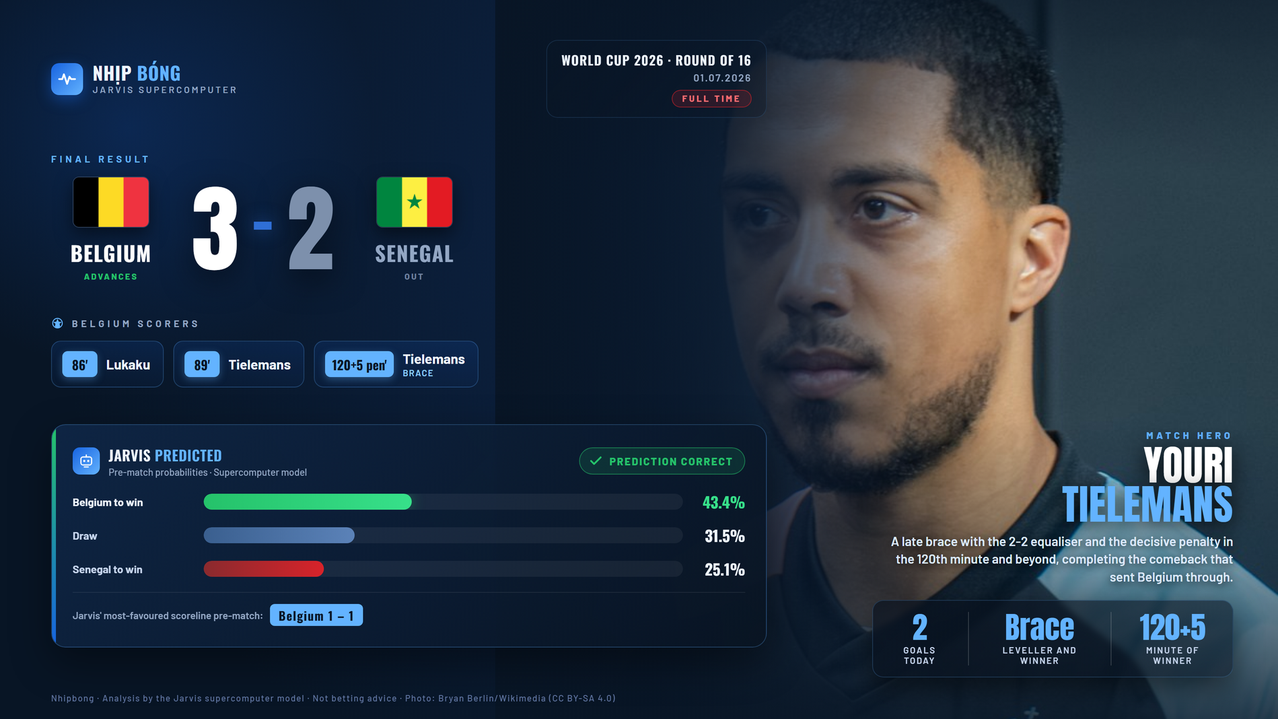
Belgium beat Senegal 3–2 in the FIFA World Cup round of 32, after 120 minutes and a full comeback. Senegal led 2–0 through Habib Diarra (24 minutes) and Ismaïla Sarr (51). Belgium only came back at the death: Romelu Lukaku pulled one back on 86 minutes, Youri Tielemans headed the equaliser on 89 to force extra time, and Tielemans then won it from the penalty spot at 120+5.
With 5 goals scored in total, this was clearly not a tight defensive affair. Senegal led from the 24th minute until the 89th, and only in the closing stages did Belgium turn the game around to edge it.
Key Takeaway

The standout detail here is the total goal count. Before the match, the Jarvis supercomputer model projected a combined expected total of only around 2.26 goals for both sides. The actual game blew past that figure with 5 goals scored, more than double the expectation.
On top of that, the predicted score Jarvis pointed to before kickoff was 2–0, a scenario that leaned heavily toward Belgium and a clean sheet. In the end Belgium did win, but through a back-and-forth match in which they conceded 2 goals, a much tighter and more contested victory than the model's initial picture suggested.
Jarvis Check: Pre-Match Forecast vs Actual Result


This is the most telling part of the piece: setting Jarvis's pre-match forecast next to the real result to see where the model got it right and where it fell short. Before kickoff, Jarvis rated Belgium to win at 43%, a draw at 31%, and Senegal to win at 25%. Across the three scenarios, Belgium was rated the favourite, but not by an overwhelming margin, only a few points clear of the draw and not miles ahead of Senegal.
The actual result, Belgium winning 3–2, landed exactly on the side Jarvis leaned toward most. That is where the model got it right: the outcome with the highest probability among the three scenarios is the one that happened.
But look closer and the gap shows up in the scoreline and the goal count. The predicted score the model pointed to was 2–0, while the real result was 3–2, meaning the combined goal tally ran more than 3 goals higher than the model's initial picture. The pre-match probability Jarvis gave for 3 or more goals in the match was only 39%, meaning a lower-scoring scenario was seen as the more likely path. Instead, the match produced 5 goals, landing in the lower-probability bracket by the model's own numbers.
Notably, Jarvis had already tagged this match with a LOW confidence label before a ball was kicked. Looking back after the final whistle, that low rating turns out to have been fairly accurate: the final result fell outside the model's central scenario, and this is exactly the kind of match Jarvis itself had flagged as hard to call from the start.
Tactical Angle: Reading Through the Probability Framework and Goal Markers

This section reads the tactical picture through Jarvis's probability framework and goal thresholds, set against the real order of the goals: Senegal scored the first two, and all three of Belgium's goals came from the 86th minute onwards.
The fact that Senegal scored 2 goals despite being rated lower than Belgium for a full win (25% versus 43%) is worth noting: a lower win probability does not mean a team cannot find the net. A tight 3–2 win with both sides scoring points to an open contest where each team had spells of pressure, a far cry from the clean-sheet picture modeled by the 2–0 predicted score.
What the Probability Numbers Actually Mean
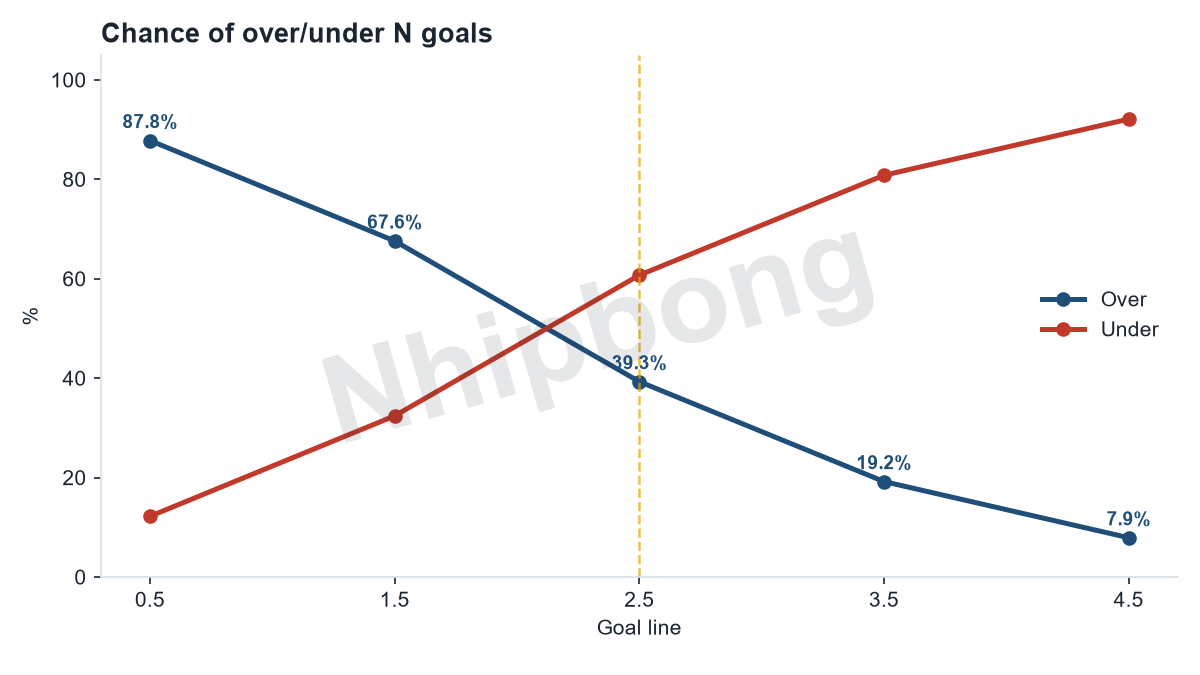
The 43% Jarvis gave Belgium before the match is not a guaranteed promise of victory, it is a way of quantifying confidence based on the data the model could process at that point in time. The three scenarios of 43%, 31%, and 25% add up to exactly 100%, showing that a win, draw, or loss were all live possibilities, and the percentages only reflect which scenario the data leaned toward more, without ruling out the other two.
That is exactly why the LOW confidence label attached to this forecast matters so much. It is an active, upfront signal that the model could not be sure how the match would play out. A result landing right in the lower-probability bracket that the model itself flagged as less reliable does not mean the model malfunctioned, if anything it shows the model knows how to measure its own limits. Reading probability correctly means treating it as a data-grounded measure of likelihood, not a prophecy, and anyone following football data should get used to results occasionally landing in the smaller percentage.
Data Source
Every probability, predicted score, expected goal total, and confidence rating mentioned in this piece comes from the Jarvis supercomputer model, calculated before the match kicked off. The actual 3–2 scoreline used for comparison is the confirmed final result of the match.
This is statistical analysis, not betting advice.
Frequently asked questions
What was Jarvis's pre-match score prediction for Belgium vs Senegal?
Jarvis pointed to a predicted score of 2–0 in Belgium's favour, along with a 43% probability for Belgium to win, 31% for a draw, and 25% for Senegal to win. This was the scenario the model leaned toward before kickoff, not a guaranteed outcome.
What was the actual result of the Belgium vs Senegal match?
Belgium beat Senegal 3–2 at the FIFA World Cup.
Where did Jarvis's forecast get it right, and where did it miss?
It got the direction right: Belgium, the pre-match favourite at 43%, won the game. But the actual 3–2 scoreline was far from the 2–0 predicted score, and the 5 total goals blew past both the 2.26 expected goal total and the 39% probability threshold for 3 or more goals.
Who scored the goals in this match?
Senegal went ahead through Habib Diarra (24 minutes) and Ismaïla Sarr (51). Belgium came back with goals from Romelu Lukaku (86), Youri Tielemans (89) and Tielemans again from the penalty spot at 120+5 in extra time.
Why did Jarvis attach a low confidence rating to this match?
Before the match even started, Jarvis rated its forecast confidence as LOW, meaning the model itself flagged the game as hard to call. The 3–2 result with 5 goals, falling outside the model's central scenario, shows that warning had real grounding.